

REVIEW · ATHENS
Athens: City Sightseeing Hop-On Hop-Off Bus Tour
Athens is a city where ancient ruins, busy squares, beaches, museums, and cruise terminals spread farther apart than they first appear. This open-top sightseeing bus gives you a useful first look, then lets you hop off near the Acropolis, Parthenon, Plaka, National Archaeological Museum, and other key sights without sorting out every taxi or metro connection.
I like the flexibility of the pass and the friendly staff stationed at many stops. I also like the choice of three routes: the central Athens line, the Piraeus line, and the long Riviera Beach route. The main catch is timing. The city route runs only until late afternoon, while the beach and Piraeus routes have limited departures, so this works best with a little planning.
Key points to know before you board

- Three pass lengths: Choose 24, 48, or 72 hours, depending on how much time you have in Athens.
- The city route covers the big sights: Acropolis, Parthenon, Plaka, Temple of Olympian Zeus, museums, the National Garden, and more.
- Piraeus and Riviera require the right ticket: Extra routes may involve a higher-priced option or an upgrade fee, so check what your booking includes.
- Audio commentary is available in 13 languages: Headphones and free WiFi are included.
- The route is useful in hot weather: Air-conditioned lower seating and shaded upper sections can make sightseeing easier.
- The schedule needs attention: Athens buses run every 20 to 30 minutes, but Piraeus and Riviera departures are much less frequent.
Why the bus works well in Athens
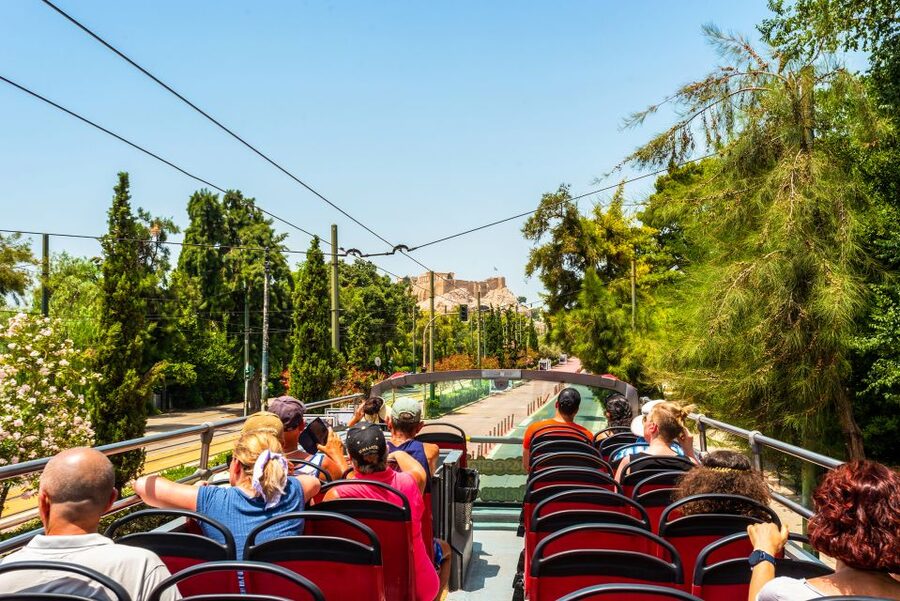
Athens is walkable in pieces, but not always comfortably. The Acropolis, National Archaeological Museum, Panathenaic Stadium, and central shopping streets are not all clustered around one square. Add summer heat, steep streets near the Acropolis, and the distance to Piraeus or the southern beaches, and a sightseeing bus can save both time and energy.
You can ride the full Athens loop in about 90 minutes, listening to the audio commentary and getting your bearings. Then you can return to the stops that interest you most. This is a better use of the bus than simply staying upstairs all day, especially if you want to visit museums or ruins rather than only photograph them from the road.
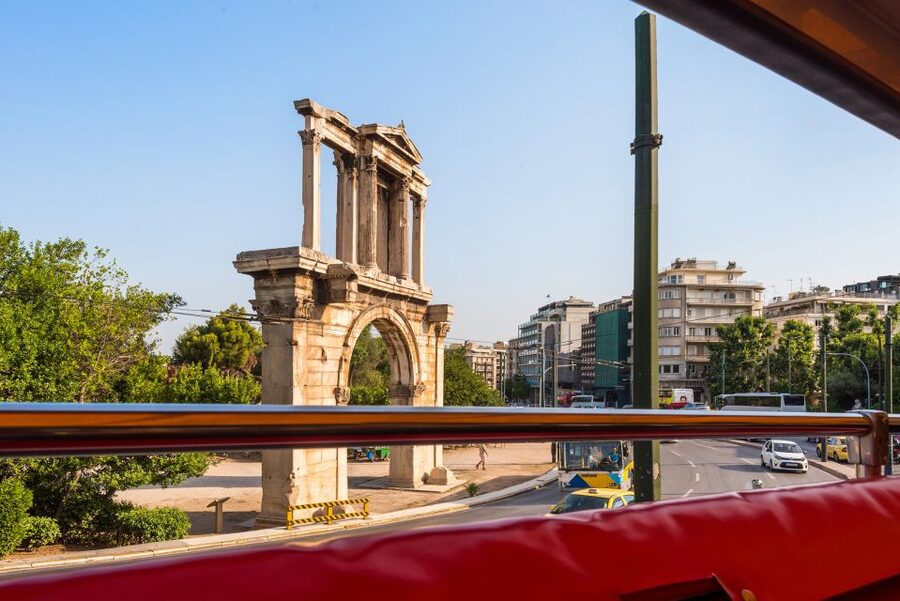
The open upper deck gives you a fine view of the Acropolis and the city streets. It is also the best place for photographs, though you need to be ready. The bus keeps moving, and covered sections can make quick shots harder. In strong summer sun, the shade is welcome. On cooler or rainy days, the enclosed lower level is more comfortable.
The onboard commentary covers Athens from ancient times to the present. It is available in English, Spanish, Turkish, Chinese, French, German, Greek, Italian, Japanese, Portuguese, Russian, Hebrew, and Dutch. The quality can vary by seat and bus, so keep the volume at a comfortable level. The commentary is tied to the route and stops, which helps you understand what you are passing rather than hearing a string of unrelated facts.
More Hop-On Hop-Off Bus Tours in Athens
- Athens, Piraeus, and Coastline: Blue Hop-On Hop-Off Bus
★ 3.9 · 4,849 reviews - City Sightseeing Athens, Piraeus & Beach Riviera Hop-On Hop-Off Bus Tours
★ 4.0 · 1,887 reviews - Athens: Big Bus Hop-on, Hop-off Tour by Open-Top Bus
★ 4.1 · 1,286 reviews
The Athens route, from Syntagma to the Acropolis
The main route begins at Syntagma Square, the city’s central meeting point. This is a practical starting place, with easy access to the Parliament and the National Garden. The first departure is listed at 8:30 a.m., and the last is at 4:30 p.m. Buses run every 20 to 30 minutes, with a total loop of about 90 minutes.
At Syntagma, you are close to the Parliament building and the National Garden. The garden is a welcome green break from the stone and traffic of central Athens. If you want a short walk before boarding, this is one of the more pleasant stops for it.
The next stops serve the Acropolis and Plaka. This is where most people will want to get off. Plaka’s lanes lead you through one of the city’s most atmospheric central neighborhoods, while the Acropolis route brings you close to the ancient citadel. The bus does not include admission to the Acropolis or any other attraction, so plan on buying separate entrance tickets.
The Acropolis Museum has its own stop. This is one of the most useful places to combine with the bus because the museum deserves more time than a quick photo stop. You can visit the galleries, then rejoin the route later. The nearby Acropolis and Parthenon stop also connects with the Piraeus route, making it the key transfer point for the wider network.
The Temple of Olympian Zeus comes next. These huge ancient columns are easy to appreciate from the roadside, but you can also hop off if you want a closer look. The stop links the Acropolis area with the central city and can save you a long walk around busy streets.
The route then reaches the Parliament and National Gardens again, followed by the Four Museums and the National Gallery. The Four Museums stop is useful if you want to build a museum-focused day, while the National Gallery gives art lovers a reason to leave the main archaeological circuit.
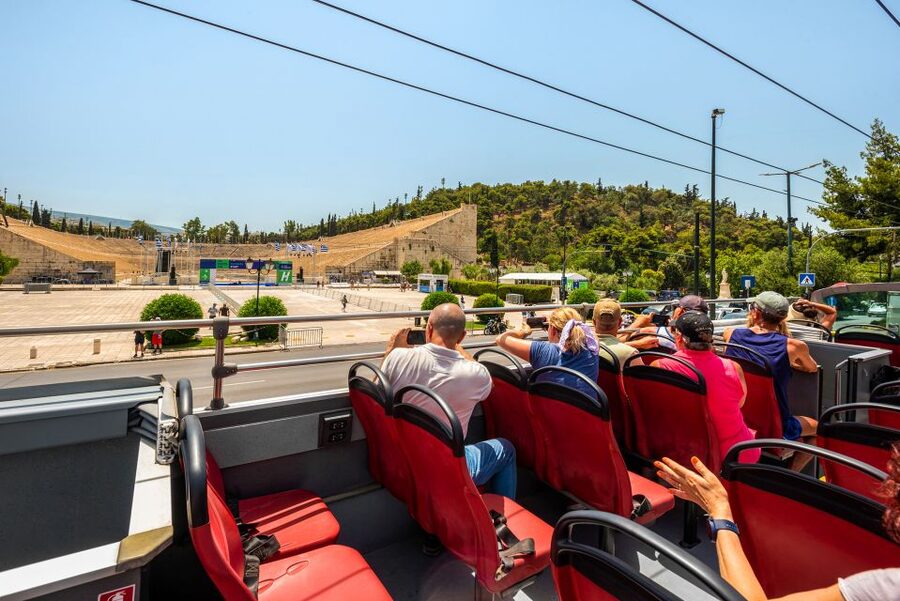
The Panathenaic Stadium is another worthwhile stop. The white marble stadium hosted the first modern Olympic Games in 1896, and its shape is easy to understand from the elevated bus. You can get off for a closer look, though you should allow time if you plan to enter.
The later city stops include the National Library, National Archaeological Museum, Omonoia Square, Karaiskaki Square, Monastiraki Square, and Kotzia Square. The National Archaeological Museum deserves special attention. It holds some of Greece’s most important ancient works, so it is a strong choice for a longer stop rather than a quick look.
Monastiraki is one of the most useful places to leave the bus for food, shopping, and a walk toward the Acropolis. Kotzia Square and Omonoia give you a different view of central Athens, away from the postcard sights. The city loop sometimes doubles back, which can make the ride feel slow if you are trying to reach a stop near the end of the route. If you are in a hurry, get off earlier and use the bus as a sightseeing connection rather than a direct taxi replacement.
Piraeus route for the port and waterfront

The Piraeus route is helpful if you are staying near the port, arriving on a cruise, or want to see Athens beyond the historic center. It connects with the Athens route at the Acropolis and Parthenon stop.
This route includes Pantion University, the Stavros Niarchos Foundation, the Municipal Theatre, the cruise terminals, Lions Gate, the Archaeological Museum of Piraeus, Votsalakia Beach, Mikrolimano Harbour, the Planetarium, and stops near major hotels and the southern edge of central Athens.
The Stavros Niarchos Foundation is one of the more modern sights on the route. It gives you a break from ancient temples and shows a newer side of the city. The Municipal Theatre and Archaeological Museum of Piraeus add cultural interest, while Mikrolimano Harbour and Votsalakia Beach offer a change of pace beside the water.
The schedule is the main concern. Piraeus departures are listed at 11 a.m. and 3 p.m., with a route time of about 80 minutes. Missing a connection can cost you a large part of the day, so check the departure time before hopping off.
Cruise passengers should also pay close attention to the ticket type. Reaching the Athens city route from a cruise terminal may require an additional payment or a specific combined ticket. Do not assume the basic city ticket covers every line. Ask the stop agent before boarding.
Riviera Beach route and Lake Vouliagmeni
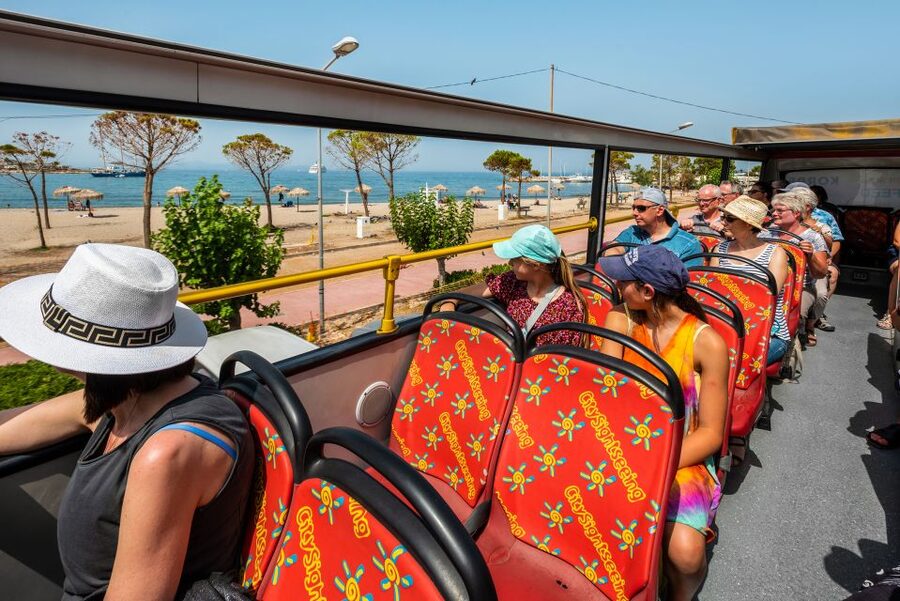
The Riviera route runs south from the Acropolis and Plaka toward the coast. It serves Pantion University, the Stavros Niarchos Foundation, Flisvos, Edem, several beaches, Glyfada, the golf area, Alimos, and Lake Vouliagmeni.
This is a long outing, not a quick add-on. The listed route takes about 110 minutes, and departures are at 11 a.m., 1 p.m., and 3 p.m. If you want time at the beach or lake, choose an early departure and check the return schedule before getting off.
The stops include Falire and Flisvos, Edem, Agios Kosmas, Bomo Palace, Asteria Beach, Oceanis Beach, Vouliagmeni Lake, Pigadakia, Blazer Suites, Glyfada town, and the coastal hotel area. Glyfada is useful for shopping and a meal, while the beach stops let you see a more relaxed side of Athens.
Lake Vouliagmeni is one of the more distinctive stops on the route. It gives you a chance to trade ancient ruins for a coastal setting without arranging a separate excursion. The bus only provides transport and sightseeing commentary, so entrance fees, food, drinks, and any beach costs are your responsibility.
The Riviera line is best for a second day or for a long 72-hour pass. You can fit it into one day with careful timing, but that leaves little room for museums or a slow lunch. A 48-hour ticket gives you more breathing space.
More Hop-On Hop-Off Bus Tours in Greece
- Hop on Hop Off Classic tour of Athens, Piraeus & Beaches
★ 3.5 · 1,266 reviews - Big Bus Athens Hop-On Hop-Off with optional Piraeus & Riviera
★ 4.0 · 652 reviews - Athens Shore Excursion: Athens and Piraeus Hop-On Hop-Off Bus Tour
★ 4.0 · 617 reviews - Athens:City Pass with Acropolis, Museums, Hop-On Hop-Off Bus
★ 3.9 · 586 reviews
Choosing between 24, 48, and 72 hours

The 24-hour pass suits a short stay when you mainly want to see the Athens route. You can ride the loop once, then hop off at the Acropolis, Acropolis Museum, Monastiraki, or the National Archaeological Museum. It is also enough for a quick overview if you are in Athens between cruise or ferry connections.
The 48-hour pass is the better choice for most visitors who want to explore rather than rush. Use the first day for the Acropolis and central Athens, then use the second for museums, Piraeus, or the Riviera. You can also ride the full route first and decide where to spend more time afterward.
The 72-hour pass makes sense if you want all three routes and prefer a slower pace. It is especially useful if you plan to visit several museums, spend time at the coast, and use the bus as transport between different parts of town.
At about $25 per person, the basic pass can be good value if you use it for both sightseeing and transport. A couple of taxi rides between distant stops can quickly narrow the price difference. The value is weaker if you only want a single transfer or plan to walk everywhere.
Check the exact option before paying. Some bookings cover only the Athens line, while a combined Athens, Riviera, and Piraeus ticket may cost more. A 5 euro per person upgrade fee has also been reported for adding other lines, so ask clearly what is included before you board.
Practical details that make the day easier
Your mobile or printed voucher must be exchanged for the actual bus ticket by an agent at a stop or on the bus. Keep the paper ticket safe once it is issued. The voucher itself is not the boarding ticket.
Staff at the stops can be genuinely useful for route planning. Ask how to shorten a ride, where to change lines, and how long the next bus should take. Some stops are close to hotels and central landmarks, but you should still check the exact stop location before setting out. Bus tracking availability can help you judge the wait.
The bus is wheelchair accessible. Pets and smoking are not allowed. Bring a passport or ID card, as requested in the tour information.
A free glass of Greek beer is available at the Syntagma Square stop, except on Sundays and bank holidays. It is a small extra, but a pleasant way to end a city loop. Food and other drinks are not included.
The listed schedule is more limited than some all-day city buses. The Athens route ends at 4:30 p.m., although individual operating days and service patterns can vary. Do not plan on using it for late-night transport. If you want a sunset ride or dinner connection, confirm the final departure first.
Free cancellation is available up to 24 hours before the selected date, and you can reserve now and pay later. The voucher can be used on any day within 12 months of the travel date selected at checkout, according to the stated conditions.
Who should book this Athens bus tour?

I recommend it most for first-time visitors, families, older travelers, cruise passengers, and anyone visiting during very hot weather. It gives you an organized first look without forcing you into a fixed walking group or a full-day guided tour.
It also suits visitors who want to mix major ruins with museums, shopping areas, beaches, and Piraeus. The staff, clear stop announcements, and working audio ports make it easier to understand the route once you have exchanged your voucher.
I would think twice if you have only a few hours and need direct transport. The bus can be slow on the city loop, and the Piraeus and Riviera routes have limited departures. For a tight schedule, choose only the stops that matter most and avoid trying to cover all three routes.
Should you book it?
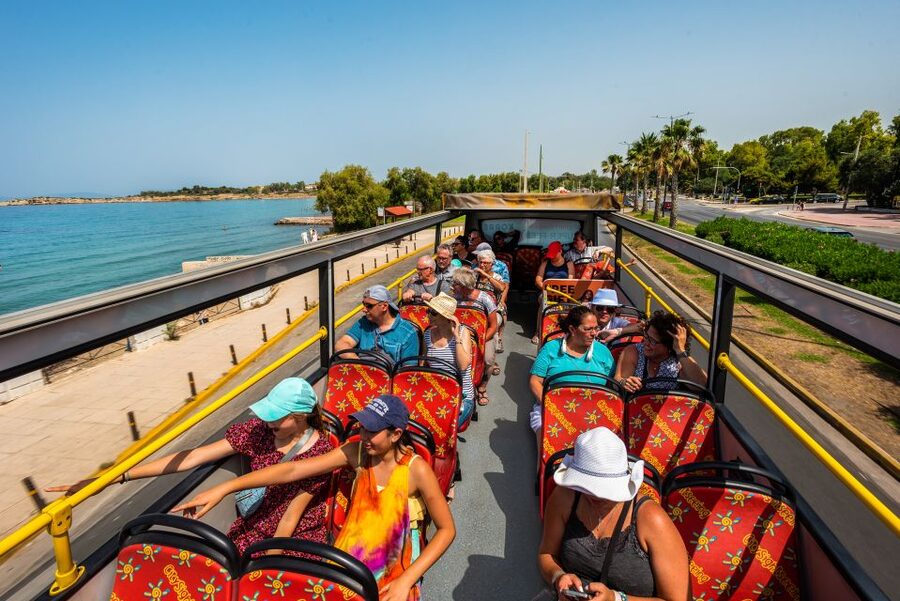
Book the 24-hour Athens pass if you want a quick orientation and easy access to the Acropolis area, museums, and central squares. Choose 48 hours if you want a relaxed mix of Athens and one extra route. The 72-hour option is best when Piraeus and the Riviera are both part of your plan.
The strongest reason to book is simple: you can see a lot of Athens without walking every hot, hilly, traffic-filled stretch. Just confirm which routes your ticket covers, watch the final departure times, and treat the bus as a flexible sightseeing tool rather than a fast city taxi.
FAQ
How long is the Athens bus pass valid?
You can choose a 24-hour, 48-hour, or 72-hour pass, depending on the option selected.
What time does the Athens route begin and end?
The first Athens route departure is listed at 8:30 a.m., and the last departure is at 4:30 p.m.
How often do Athens route buses run?
The Athens route runs approximately every 20 to 30 minutes.
How long does the Athens city loop take?
The full Athens route takes about 90 minutes.
How often does the Piraeus route depart?
The listed Piraeus departures are at 11 a.m. and 3 p.m. The route takes about 80 minutes.
How often does the Riviera Beach route depart?
The Riviera route is listed at 11 a.m., 1 p.m., and 3 p.m. The full route takes about 110 minutes.
Is the Acropolis entrance ticket included?
No. Attraction tickets, including admission to the Acropolis and museums, are not included.
What languages are available for the audio guide?
The audio guide is available in English, Spanish, Turkish, Chinese, French, German, Greek, Italian, Japanese, Portuguese, Russian, Hebrew, and Dutch.
Is the bus wheelchair accessible?
Yes, the activity is listed as wheelchair accessible.
More Sightseeing Bus Tours in Athens
- Rome: City Sightseeing Hop-on Hop-off Bus with Audioguide
★ 4.0 · 16,045 reviews - Barcelona: City Sightseeing Hop-On Hop-Off Bus Tour
★ 4.4 · 10,061 reviews - Rome: Big Bus Hop-on, Hop-off Open-Top Sightseeing Tour
★ 4.1 · 9,537 reviews - City Sightseeing London Hop-On Hop-Off Bus & Bookable Extras
★ 4.4 · 7,374 reviews
More Sightseeing Bus Tours in Greece
- Athens panoramic tour by night with open double decker bus
★ 3.9 · 58 reviews - Athens: Greek Theatre Sightseeing Bus Tour
★ 5.0 · 6 reviews - Athens Private Sightseeing Minibus Tour with Lunch
★ 4.7 · 6 reviews - Santorini: Traditional Sightseeing Bus Tour with Oia Sunset
★ 4.6 · 2,306 reviews
Just added around Athens
- PRIVATE Minibus Tour of Athens (by Piraeus Express)★ 4.0 · 13 reviews
- Private Day Trip from Athens to Meteora by VIP Minibus★ 5.0 · 2 reviews
- Hop-On Hop-Off Bus and Acropolis Museum Ticket★ 3.0 · 4 reviews
- From Athens: Small-Group Mycenae, Epidaurus & Nafplio Trip★ 5.0 · 187 reviews
- Meteora Full-Day Trip with Guide on Luxury Bus From Athens★ 3.5 · 3 reviews
- Athens Half Day Private Tour (up to 15 in a luxurious Mercedes Minibus)★ 5.0 · 4 reviews
- Pauls Biblical Ancient Corinth by Mini-bus★ 5.0 · 10 reviews
- Athens Private Full Day Tour (up to 15 in a luxurious Mercedes Minibus)★ 5.0 · 2 reviews
Athens Bus Tours, compared.
Athens, Piraeus, and Coastline: Blue Hop-On Hop-Off Bus
Read our review →
City Sightseeing Athens, Piraeus & Beach Riviera Hop-On Hop-Off Bus Tours
Read our review →

Hop on Hop Off Classic tour of Athens, Piraeus & Beaches
Read our review →
Big Bus Athens Hop-On Hop-Off with optional Piraeus & Riviera
Read our review →
Athens Shore Excursion: Athens and Piraeus Hop-On Hop-Off Bus Tour
Read our review →
City Pass with Acropolis, Museums, Hop-On Hop-Off Bus
Read our review →
Hop-on-Hop-off Bus and Cape Sounion Sunset Tour
Read our review →Browse the lists this tour appears in