

REVIEW · SPAIN
Barcelona: City Sightseeing Hop-On Hop-Off Bus Tour
Barcelona’s best sightseeing trick is simple: sit on the top deck, let the city roll past, then get off when something catches your eye. This 24 or 48-hour ticket links the far-flung sights that are awkward to cover on foot, from Montjuïc and the Olympic area to Park Güell, Sagrada Família, the beaches, and FC Barcelona.
I like the freedom to mix sightseeing with real stops, rather than staring at landmarks through a taxi window. I also like the two-route design, the useful audio commentary, and the fact that you can use the same ticket on both the Red and Blue routes. The main caution is time: the buses stop at 7pm, and traffic, crowds, and long visits can make a carefully packed day feel rushed.
The most useful approach is to treat this as both an orientation ride and a moving connection between neighborhoods. You will see more by choosing a few stops instead of trying to conquer all 38 in one day.
Key points to know before you board
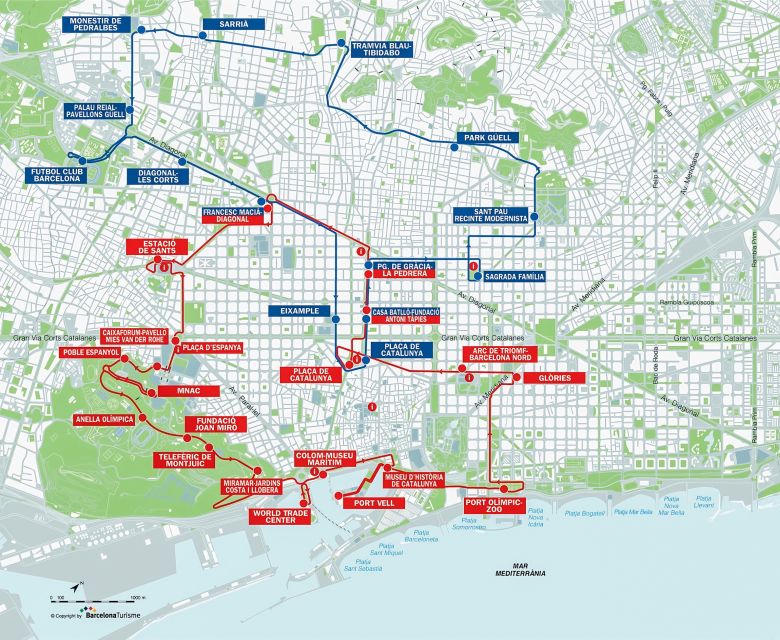
- Two routes cover very different Barcelonas: The Red Route focuses on Montjuïc, the waterfront, beaches, Poblenou, the center, and Sagrada Família. The Blue Route reaches Park Güell, Tibidabo, Pedralbes, and FC Barcelona.
- A full loop takes about 120 minutes: That is sightseeing time without getting off, so allow extra hours for traffic, meals, museum visits, and waiting.
- The bus runs from 9am to 7pm: The last departure is from Stop 1, Plaça de Catalunya, not necessarily from the stop where you happen to finish.
- The audio guide adds useful context: Commentary is offered in 16 languages, including English, Spanish, Catalan, French, German, Italian, Chinese, Japanese, Arabic, and Turkish.
- Park Güell requires planning: The bus stop involves a long, steep uphill walk, which can be difficult for anyone with limited mobility.
- The 48-hour ticket works on consecutive days: It is the better choice if you want time for museums, meals, and proper visits instead of a quick look from the road.
Why the bus works well in a spread-out city

Barcelona looks compact on a map, but its main sights are scattered across several districts. The Gothic Quarter and La Rambla sit near the old port, Gaudí’s grand buildings line the Eixample, Park Güell climbs above the city, and Montjuïc rises on the opposite side of the center.
That is where this bus earns its keep. You can ride from the center to Sagrada Família, continue toward the coast, then switch routes to reach Park Güell or Camp Nou without working out a new metro connection each time. You still need to walk at each attraction, but the bus saves energy between them.
I would use the tour early in a Barcelona visit. The first loop gives you a clear sense of where the major districts sit, and the audio commentary helps explain why a plain-looking boulevard, square, or block matters. Later, you can return to the places that deserve more time.
The buses are open-top double-deckers. On sunny days, the upper deck gives you the best views and a pleasant breeze, especially along the waterfront. In winter, it can be chilly upstairs. Rain is less of a problem than you might expect because the roof can close when needed, but summer heat and weak air conditioning on some buses can make a lower-deck seat more comfortable.
More Hop-On Hop-Off Bus Tours in Spain
- Barcelona: 24 or 48-Hour Hop-On Hop-Off Bus Tour
★ 4.4 · 20,872 reviews - City Sightseeing Barcelona Hop-On Hop-Off Bus Tour: 24 or 48-Hour
★ 4.0 · 5,250 reviews - Barcelona City Tour Hop-On Hop-Off with Optional Boat
★ 4.0 · 3,012 reviews
Red Route: from Gaudí to the sea
The Red Route is the stronger choice if you want a broad look at Barcelona in one afternoon. It combines central architecture, Montjuïc, the port, the beaches, newer districts, and Sagrada Família.
Plaça de Catalunya and Casa Batlló
Plaça de Catalunya is the practical starting point, with connections into the center and a short walk toward La Rambla and the Gothic Quarter. The next stop, Casa Batlló and the Fundació Antoni Tàpies, puts you in the heart of the Eixample, where Antoni Gaudí’s playful façades turn ordinary city blocks into outdoor architecture galleries.
You can see Casa Batlló from the street, but the interior visit needs a separate ticket. The bus is useful here as an introduction, not a substitute for going inside.
Sants, Plaça d’Espanya, and Montjuïc
The Red Route then reaches Estació de Sants and Plaça d’Espanya. Plaça d’Espanya is one of the city’s most impressive transport and public-space hubs, with views toward Montjuïc and the National Art Museum of Catalonia.
The CaixaForum and the Mies van der Rohe Pavilion make this area worthwhile for modern architecture and art. Poble Espanyol offers a purpose-built display of Spanish regional architecture, while the Museu Nacional d’Art de Catalunya is the major stop for art and broad city views.
Continue to the Olympic Ring, the Joan Miró Foundation, the Montjuïc cable-car area, and Miramar. These stops show a quieter, hillier side of Barcelona, but allow time. Montjuïc attractions are spread out, and you can lose much of a day by trying to visit everything.
More Sightseeing Bus Tours in Spain
- Seville: City Sightseeing Hop-On Hop-Off Bus Tour
★ 4.0 · 4,633 reviews - Palma de Mallorca: City Sightseeing Hop-On Hop-Off Bus Tour
★ 4.1 · 4,450 reviews - Madrid Panoramic City Bus Tour
★ 3.5 · 3,118 reviews - Malaga: City Sightseeing Hop-On Hop-Off Bus Tour
★ 4.0 · 2,619 reviews
The port, La Rambla, and the old waterfront
The route descends toward the World Trade Center and the Columbus monument at the lower end of La Rambla. This is your gateway to the port, the maritime museum area, and the old city.
La Rambla is lively at almost any hour, with cafés, shops, street activity, and easy access to the Gothic Quarter. I would not use the bus stop as your only visit to the old center. Get off, walk the medieval lanes, and make your way toward the Picasso Museum if that is on your list. The museum has one of the largest collections of Picasso’s work, but entry is not included in the bus ticket.
The Gothic Quarter is best explored slowly. The bus gives you the location; your feet provide the experience.
Port Olímpic, beaches, and Poblenou
The Red Route continues along Port Olímpic and the beaches at Bogatell and Nova Mar Bella. This section is especially useful in warm weather, when you may want a break from churches and museums.
The ride also reaches the Forum, Diagonal Mar, Poblenou, and Torre Glòries. These stops show the city’s newer waterfront districts and former industrial areas. They are less essential if you have only a few hours, but they help you understand how far Barcelona extends beyond the old center.
Sagrada Família and Arc de Triomf
Sagrada Família is the essential stop on the Red Route. Gaudí’s basilica is one of Barcelona’s defining sights, and the exterior alone is worth a close look. The bus stop also makes it easy to return for a booked interior visit, but your attraction ticket is separate.
Plan your time carefully here. Sagrada Família can be crowded, and the stop itself may be busy enough that you do not board the first bus. A photo point behind the basilica gives you a useful angle away from the main façade.
The final central stops include Arc de Triomf. The bus does not necessarily place you directly at every monument, so watch the map and signs. A short walk may be required.
Blue Route: Gaudí, Tibidabo, and FC Barcelona

The Blue Route is more focused on the city’s upper districts and major Gaudí sites. I would choose it first if Park Güell or Sagrada Família is your main priority.
Passeig de Gràcia and La Pedrera
After Plaça de Catalunya and Casa Batlló, the route moves along Passeig de Gràcia toward La Pedrera, also called Casa Milà. This broad avenue is one of the best places to see Barcelona’s modernist architecture without a museum ticket.
Both Casa Batlló and La Pedrera require separate admission if you want to go inside. If you are short on time, you can simply ride this stretch and return later for the building that interests you most.
Sant Pau and Park Güell
The Sant Pau Recinte Modernista is an important stop for architecture. Its buildings and gardens offer a different view of Catalan modernism, less famous than Gaudí but just as useful for understanding the period.
Park Güell is the Blue Route’s big challenge. The park is high above the central city, and the bus stop is followed by a long, steep uphill walk. That matters for families with small children, anyone carrying luggage, and people with limited mobility.
Give Park Güell proper time. A quick photo stop can feel unsatisfying, especially after the climb. Entry to the park’s ticketed areas is not included, and you should check availability before relying on a same-day visit.
Tibidabo, Sarrià, and Pedralbes
The route continues toward Tramvia Blau and Tibidabo, then through Sarrià. This part of the ride takes you away from the main tourist core and into quieter residential districts.
The Monestir de Pedralbes is another worthwhile stop for art, architecture, and a calmer setting. The Palau Reial and Güell Pavilions add more modernist and royal history to the route, though you will need to decide how much time you want to spend away from the central sights.
FC Barcelona and Les Corts
Football fans should get off at FC Barcelona. The stop is an easy way to include the club’s famous stadium area, but the ticket does not include attraction entry.
If football is not part of your plan, this section can feel like a long detour. One useful way to handle it is to stay on the bus for the ride, enjoy the changing city views, and get off only if the club matters to you.
The route returns through Diagonal, Les Corts, Francesc Macià, Eixample, and Sant Antoni. Sant Antoni is a practical final stop for food and neighborhood wandering, while Diagonal helps show the scale of Barcelona’s main avenue.
How to plan one day without rushing
A 24-hour ticket is valid for 24 hours, not simply until midnight. That gives you some flexibility. You can begin one afternoon on the Red Route, ride through Montjuïc and the waterfront, then use the Blue Route the following morning before the ticket expires.
Still, you should not treat one day as enough for every attraction. A sensible plan is:
- Ride the Blue Route and get off at one major sight, such as Sagrada Família or Park Güell.
- Use the Red Route for Montjuïc, the waterfront, or the beaches.
- Add one central walking section around the Gothic Quarter, La Rambla, or the Picasso Museum.
- Leave spare time for meals, queues, traffic, and the walk back to each stop.
The whole loop takes around two hours, and that is before you get off. One rider’s useful advice was to think of the 24-hour ticket as two partial days, not one frantic circuit.
The 48-hour ticket is better if you want to visit museums or booked attractions. It must be used on consecutive days, but two full operating days let you spread out the climbs, walking, and indoor visits.
Timing, stops, and the practical details
Buses are scheduled about every 20 minutes, and special high-season service may run more often. In practice, traffic and crowded stops can affect the wait. Sagrada Família is one place where the first arriving bus may already be full.
The first bus leaves Stop 1 at 9am, and the last bus leaves Stop 1 at 7pm on both routes. Do not assume you can board near your hotel at 7pm and still ride back to the center. If you are finishing at an outer stop, check the time and keep a taxi or public transport option in mind.
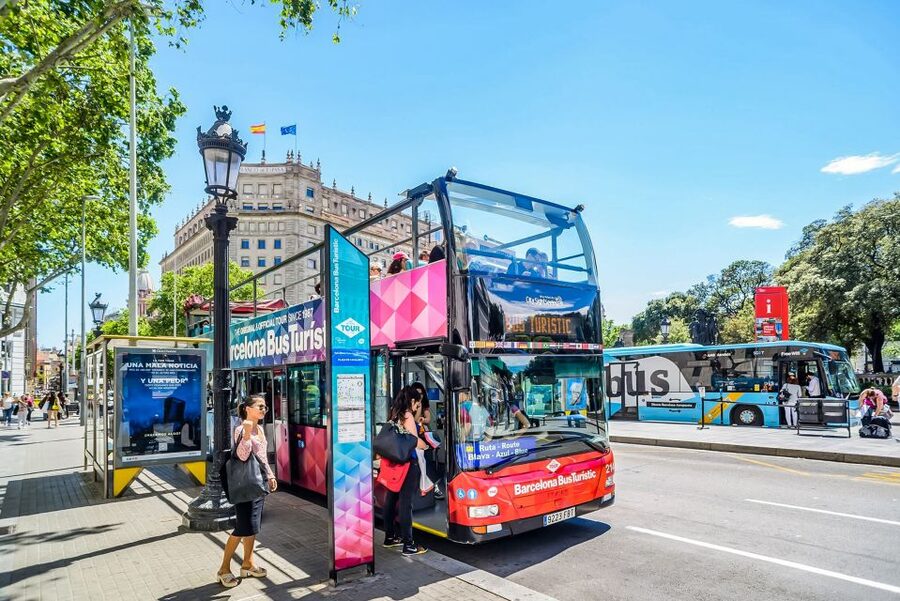
The buses are branded Barcelona Bus Turistic, which makes them easier to identify. You can use a mobile or printed voucher, and headphones are supplied. You can also bring your own headphones, which may be more comfortable.
Free Wi-Fi is included, but it may not work on every bus. The city map and discount booklet can help with orientation, though I would download or print the stop information before setting out. Finding the correct stop around Sagrada Família can be confusing if you are relying on the map for the first time.
The bus does not include hotel pickup, food, drinks, or attraction admission. Pets and smoking are not allowed.
Is the $39 price good value?

At about $39 per person, the tour costs more than using the metro for simple point-to-point transport. The metro is usually the better tool when you already know exactly where you are going and want the fastest connection.
The bus earns its price in three ways. First, it joins distant sightseeing areas without requiring you to plan each transfer. Second, the audio guide gives you context while you ride. Third, it reduces walking between major stops, which matters on hot days or when you are traveling with children, teenagers, or someone with limited stamina.
I would consider the 24-hour ticket good value if you use both routes and get off several times. The 48-hour ticket makes more sense if you plan to use the bus as transport over two consecutive days.
The value drops if you stay on for one loop, skip the Blue Route, or use it only to reach Camp Nou. In that case, public transport may be cheaper. Also remember that entry to Sagrada Família, Park Güell, the Picasso Museum, Montjuïc attractions, and FC Barcelona is extra.
Who will get the most from this tour?
I recommend it most to first-time visitors who want quick orientation, families who need to limit walking, and anyone staying only a day or two. Teenagers often appreciate the open-top ride and the football stop, while adults get a clear overview without constant map reading.
It is also useful for visitors with mobility concerns, though Park Güell’s uphill approach deserves special thought. The bus itself offers a seated way to see a large portion of the city, but every attraction still involves some walking and not every stop places you right at the entrance.
Independent walkers may prefer the metro and a detailed neighborhood plan. The bus is slower than the metro, and traffic can make a fixed appointment harder to reach. Use it for seeing the city, not for cutting every journey to the shortest possible time.
Should you book the Barcelona hop-on hop-off bus?
Book it if you want a simple first look at Barcelona, need to connect far-apart sights, or prefer sitting down between visits. The two routes cover an unusually useful mix, from Gothic streets and La Rambla to beaches, Montjuïc, Park Güell, Sagrada Família, and FC Barcelona.
Choose the 24-hour ticket for a focused first day. Choose 48 hours if you want museums, longer meals, and proper visits rather than quick photographs. Skip it if you are comfortable with the metro and plan to explore only one compact neighborhood.
My best advice is to start early, use both routes, and protect your schedule from overplanning. Pick two or three major stops, keep the last bus time in mind, and let the ride fill in the spaces between them.
FAQ
How long does the Barcelona hop-on hop-off tour last?
A complete route takes about 120 minutes without getting off the bus. Your 24 or 48-hour ticket allows you to leave and rejoin during the valid period.
Can I use one ticket on both the Red and Blue routes?
Yes. The ticket gives you access to both routes, which together cover 38 stops across Barcelona.
What time do the buses operate?
The first bus leaves Stop 1 at 9am, and the last bus leaves Stop 1 at 7pm. The buses generally run about every 20 minutes, with more frequent service possible during high season.
Is the 48-hour ticket valid on any two days?
No. The 48-hour ticket must be used on consecutive days.
Is Park Güell close to the bus stop?
The bus stop requires a long, steep uphill walk to Park Güell. Plan extra time, especially if walking uphill is difficult for you.
Are attraction tickets included?
No. Entry to Sagrada Família, Park Güell, the Picasso Museum, FC Barcelona, and other attractions is not included.
Is an audio guide available?
Yes. Audio commentary is included in 16 languages, including English, Spanish, Catalan, French, German, Italian, Chinese, Japanese, Portuguese, Russian, Dutch, Hebrew, Swedish, Arabic, Turkish, and Norwegian.
More Sightseeing Bus Tours in Barcelona
- Rome: City Sightseeing Hop-on Hop-off Bus with Audioguide
★ 4.0 · 16,045 reviews - Rome: Big Bus Hop-on, Hop-off Open-Top Sightseeing Tour
★ 4.1 · 9,537 reviews - City Sightseeing London Hop-On Hop-Off Bus & Bookable Extras
★ 4.4 · 7,374 reviews - Hamburg: Line A Sightseeing Hop-On Hop-Off Bus Tour
★ 4.6 · 6,958 reviews
More Hop-On Hop-Off Bus Tours in Barcelona
- Barcelona: Hop-On Hop-Off Bus with Sailing Cruise
★ 4.3 · 412 reviews - Barcelona Hop-On Hop-Off Bus and FC Barcelona Immersive Tour
★ 4.2 · 362 reviews - Shore Excursion: Barcelona City Tour Hop-On Hop-Off
★ 4.0 · 280 reviews - Barcelona: Hop-On Hop-Off Bus & Aquarium Tour
★ 4.5 · 221 reviews
Just added around Barcelona
- Private Customized Barcelona Tour by Mercedes VIP Bus and Personal Expert Guide★ 5.0 · 4 reviews
- Shore Excursion: Barcelona City Tour Hop-On Hop-Off★ 4.0 · 280 reviews
- Barcelona City Tour Hop-On Hop-Off and Aquarium★ 4.5 · 6 reviews
- Barcelona Hop on Top City Tour★ 3.5 · 12 reviews
- Barcelona City Card with 30+Attractions, Tours and Hop on Hop off★ 4.5 · 9 reviews
- Barcelona City Hop On Hop Off and FC Barcelona Immersive Tour★ 3.5 · 10 reviews
- Barcelona: Bus Nàutic with tapas tasting★ 3.5 · 4 reviews
- Barcelona Hop-On Hop-Off Bus and FC Barcelona Immersive Tour★ 4.2 · 362 reviews
Spain Bus Tours, compared.


City Sightseeing Barcelona Hop-On Hop-Off Bus Tour: 24 or 48-Hour
Read our review →
Palma de Mallorca: City Sightseeing Hop-On Hop-Off Bus Tour
Read our review →
Granada City Train 1 or 2-Day Hop-On Hop-Off Ticket
Read our review →
Barcelona City Tour Hop-On Hop-Off with Optional Boat
Read our review →
Malaga: City Sightseeing Hop-On Hop-Off Bus Tour
Read our review →Browse the lists this tour appears in