
REVIEW · ATHENS
Athens, Piraeus, and Coastline: Blue Hop-On Hop-Off Bus
The best thing about this bus pass is its reach. For about $14, you can connect the cruise port, central Athens, and the Athenian Riviera without paying for separate taxis or working out several city-bus routes. I especially like the easy port pickup and the chance to ride out to beaches and marinas, not just circle the ancient center.
I also like the two-day validity, which gives you breathing room after a long cruise day. The audio guide comes in 16 languages, and free Wi-Fi is useful for maps and messages. The main catch is traffic and uneven departure intervals. A short route can become a slow one, and the last bus on each line matters if you need to return to your ship.
Key points
- Four routes in one ticket: Cover Athens, Piraeus, Glyfada, and Vouliagmeni with separate Orange, Blue, Yellow, and Green lines.
- Excellent for cruise passengers: Board near Piraeus cruise Terminals A, B, or C and ride toward the Acropolis.
- A real second day: The pass is valid for two days from first activation, so you can split city sights and the coast.
- Beach access by bus: Reach Agios Kosmas, Kavouri Oceanis, Marina Flisvou, and Vouliagmeni Lake.
- Useful onboard extras: Listen in 16 languages, use free Wi-Fi, and request the supplied earphones when boarding.
- Watch the clock: Traffic, full buses, line changes, and missed stops can make the return to Piraeus take longer than expected.
From Piraeus cruise port to the Acropolis
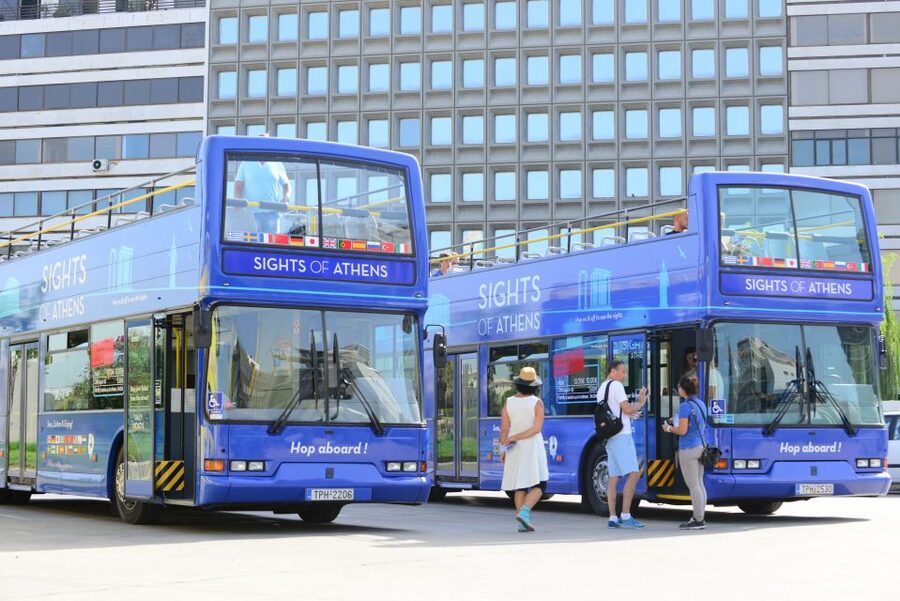
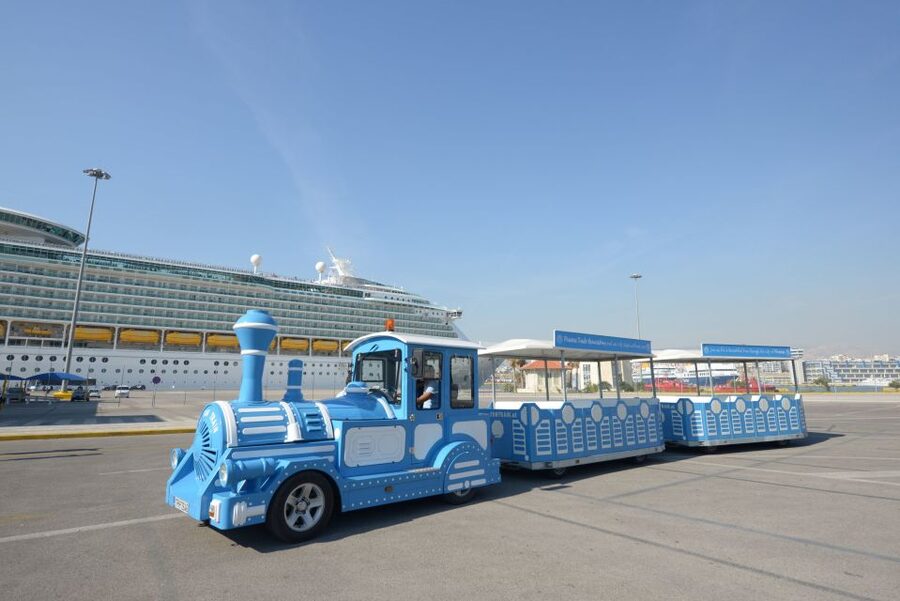
For cruise passengers, the Blue Line is the main reason to consider this pass. Buses operate from the Piraeus cruise terminals, including Terminals A, B, and C, so you can often board close to your ship rather than walk through the port or arrange a taxi.
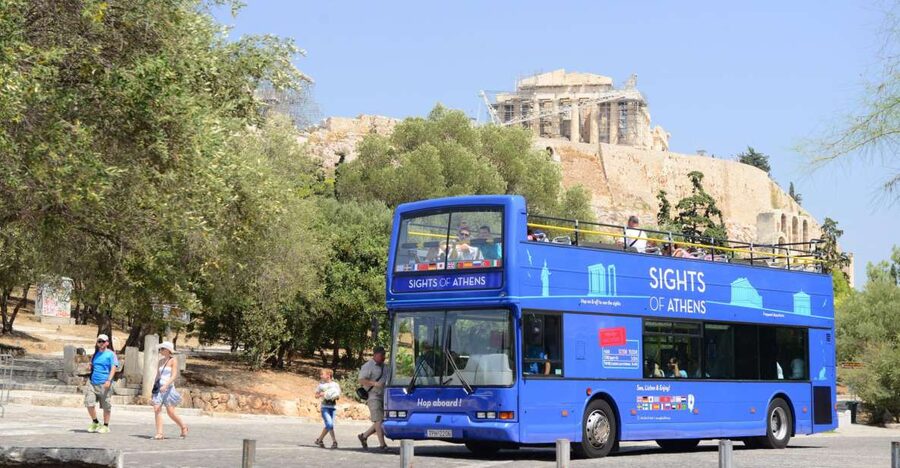
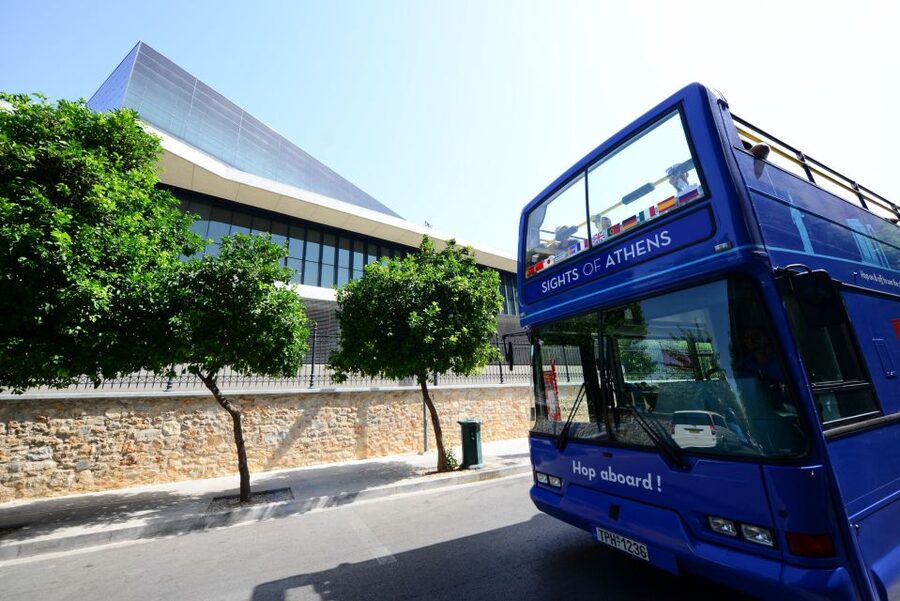
The ride toward Athens is designed for orientation as much as transport. You get views of Piraeus, then reach central stops near the Acropolis and other major sights. The Acropolis stop is especially useful because it puts you close to the hill and the Acropolis Museum.
Allow extra time on the return. The ride between Athens and Piraeus can be slowed by city traffic, and the bus may fill with people heading back to ships. At the Acropolis, several buses and lines can serve different destinations, so ask staff which bus returns to your terminal before you board.
Piraeus has its own reasons to stay on the bus. Pasalimani, the yacht marina, and Mikrolimano offer a more modern waterfront view than the ancient center. Mikrolimano, an old harbor, is a pleasant place to stop for a meal or a drink if your schedule allows.
The port has several terminals, and they are not interchangeable for a quick walk. Check your ship’s terminal before leaving Athens. A wrong stop can mean a long walk through an awkward port area, while waiting for the correct bus may be the better choice.
More Hop-On Hop-Off Bus Tours in Athens
- Athens: City Sightseeing Hop-On Hop-Off Bus Tour
★ 4.3 · 4,520 reviews - City Sightseeing Athens, Piraeus & Beach Riviera Hop-On Hop-Off Bus Tours
★ 4.0 · 1,887 reviews - Athens: Big Bus Hop-on, Hop-off Tour by Open-Top Bus
★ 4.1 · 1,286 reviews
Orange Line Athens: the useful city circuit
The Orange Line covers the central Athens sights that most first-time visitors want to see. It is not a substitute for walking through the city, but it gives you a quick sense of distances and helps you choose where to get off.
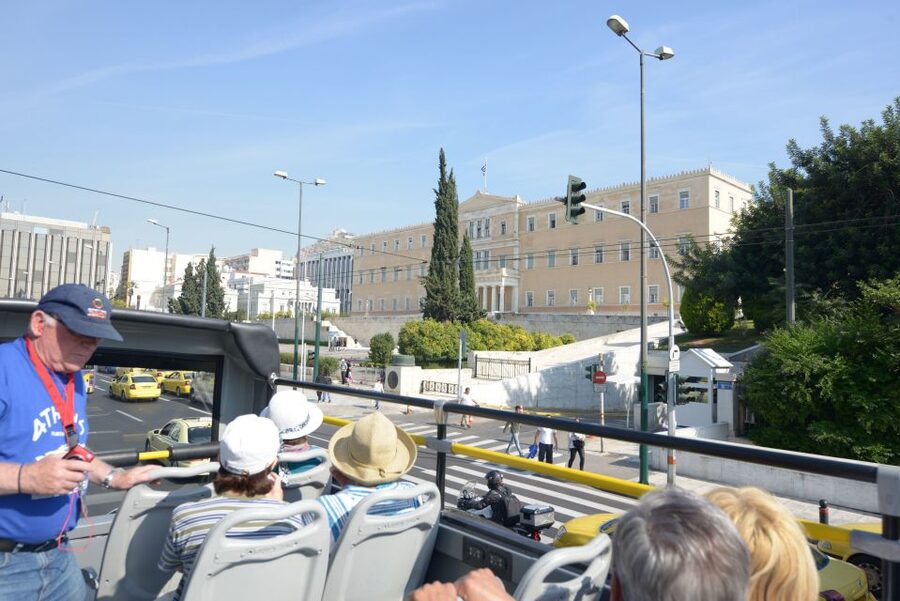
The route includes the Plaka old city, the Parliament at Syntagma Square, the Temple of Olympian Zeus, the Panathenaic Stadium, the National Library, the National Archaeological Museum, Monastiraki, and Thission.
Plaka is a good first stop if you want narrow streets, traditional-style buildings, shops, and tavernas. It sits below the Acropolis and is easy to pair with a visit to the Acropolis Museum or the archaeological site.
At Syntagma Square, you can see the Hellenic Parliament and its guards. The square is also a practical transfer point for exploring central Athens on foot. Ermou, the city’s busiest shopping street, begins nearby and leads toward Monastiraki.
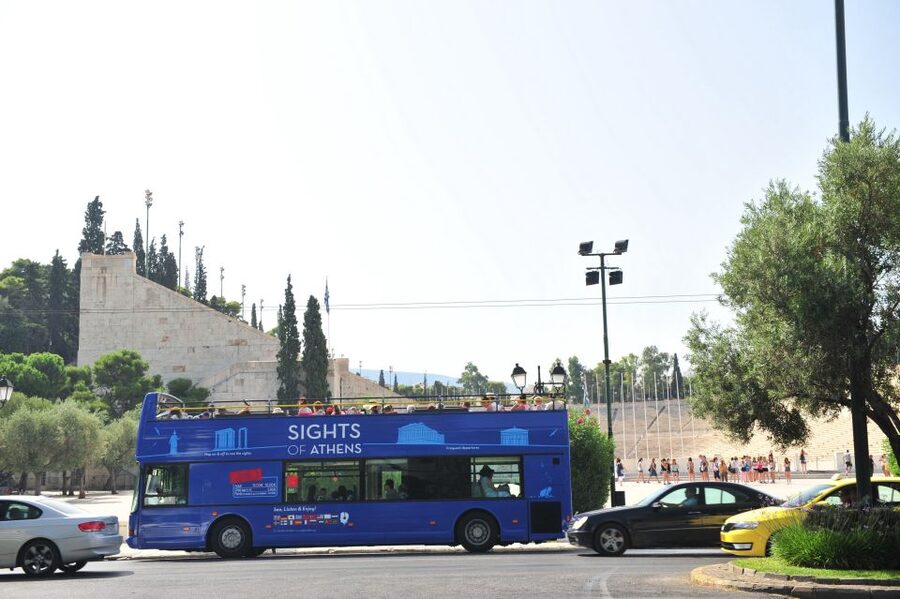
The Temple of Olympian Zeus offers a strong sense of scale. Only parts of the huge Roman-era temple remain, but the columns are easy to spot from the route. The Panathenaic Stadium is another worthwhile stop, especially if you enjoy Olympic history. It hosted the first modern Olympic Games and is built in white marble.
Monastiraki is a good place to end a city loop. Its flea market, small shops, food stops, and views toward the Acropolis make it more rewarding than simply staying on the bus. Thission is another pleasant area for a walk, with cafes and views toward the ancient hill.
You can also use the Orange Line for practical transport. If you are staying near the Acropolis, the route helps connect you with Syntagma, the museum district, and the National Archaeological Museum without a long walk in the heat.
The Acropolis stop and what it can and cannot do
The bus takes you close to the Acropolis, but your ticket does not include admission to the archaeological site or the Acropolis Museum. You need separate tickets for those attractions, and the bus does not replace a guided visit.
That separation is useful to understand before you plan. The bus handles the city transport, while you decide how much time to spend inside each place. You might use the Orange or Blue Line to reach the Acropolis, spend several hours visiting the hill and museum, then continue on the city route.
The Acropolis stop can be busy, especially in the main summer months. Staff may help point you toward the correct line, but keep your ticket and route information ready. Some departures may be full, and a short wait can become longer when many cruise passengers arrive at once.
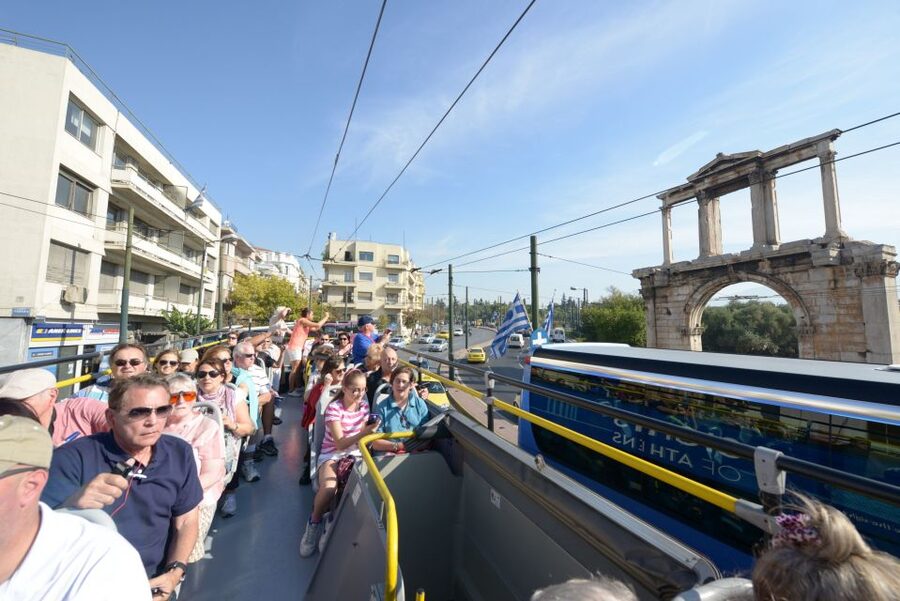
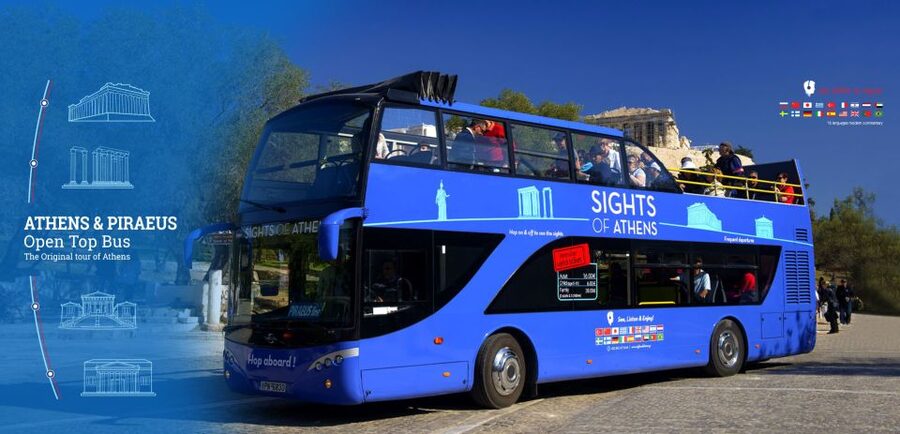
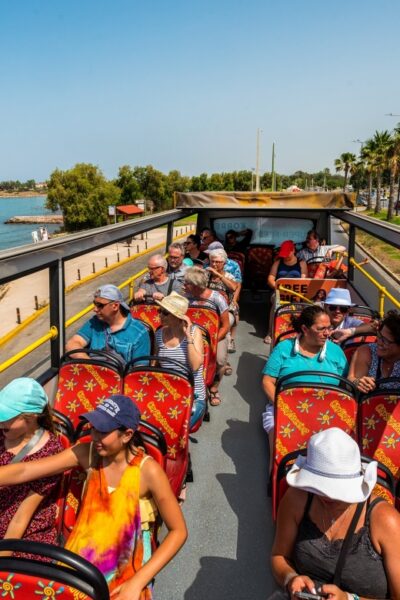
The open top deck offers better views and a fine first look at Athens. On hot days, though, the lower deck and air conditioning are more comfortable. Bring water, sunglasses, and a hat. If rain arrives, some buses offer better shelter than others, so check the vehicle before settling in.
Yellow Line: from the Planetarium to Glyfada

The Yellow Line is what makes this more than a standard Athens city tour. It begins around the Planetarium connection from the Blue Line and follows the coast toward Glyfada.
The route passes the Stavros Niarchos Foundation area and Marina Alimou, then continues toward Marina Flisvou and Agios Kosmas. You get a look at how the southern edge of Athens changes from city waterfront to marinas, beach areas, cafes, and upscale suburbs.
Marina Flisvou is a good stop for a waterside walk or sunset. Agios Kosmas is the practical beach stop if you want to swim or sunbathe without arranging a separate excursion. This is a pleasant way to use part of a free afternoon, especially if you have already seen the central monuments.
At the Glyfada terminal, you can walk through one of Athens’ more polished shopping and cafe districts. The area has luxury department stores, cafes, and beach bars. It is not an ancient site, but it gives you a different view of the capital, one shaped by seaside life and modern shopping.
Do not underestimate the timing. The coastal ride is enjoyable, but traffic can slow the return toward central Athens. If you need to catch a ship, treat the beach and Glyfada stops as a planned outing rather than an open-ended ride.
More Hop-On Hop-Off Bus Tours in Greece
- Hop on Hop Off Classic tour of Athens, Piraeus & Beaches
★ 3.5 · 1,266 reviews - Big Bus Athens Hop-On Hop-Off with optional Piraeus & Riviera
★ 4.0 · 652 reviews - Athens Shore Excursion: Athens and Piraeus Hop-On Hop-Off Bus Tour
★ 4.0 · 617 reviews - Athens:City Pass with Acropolis, Museums, Hop-On Hop-Off Bus
★ 3.9 · 586 reviews
Green Line: Vouliagmeni, Kavouri, and the lake
The Green Line continues farther down the coast to Vouliagmeni. This is the route to choose if you want a slower day by the sea and have enough time to stay away from central Athens.
Kavouri Oceanis is one of the main beach stops. You can get off for swimming, sunbathing, or a break from the stone and traffic of the city. Bring anything you need for a beach stop, since the bus ticket itself does not include admission, chairs, food, or other beach costs.
Vouliagmeni Lake is another major reason to ride this line. The area is known for thermal baths and a striking setting, giving you a chance to see a side of Athens that has little to do with the Acropolis. The Allied Forces Cemetery and Byzantine Museum add historical interest if you prefer a sightseeing stop to a beach visit.
This route works best on a second day. Trying to combine the Acropolis, central Athens, Glyfada, and Vouliagmeni in one tight cruise schedule would leave little time to get off. With two valid days, you can use one day for the Orange and Blue lines, then reserve the next for the coast.
How the four lines fit together
The pass is easiest to use when you think of it as two linked trips. The Blue and Orange lines handle Piraeus and central Athens. The Yellow and Green lines handle the southern coast.
A practical plan looks like this:
- Day one: Board at Piraeus, ride to the Acropolis, visit the hill or museum, then use the Orange Line for Plaka, Syntagma, Monastiraki, and the Panathenaic Stadium.
- Day two: Change from the Blue Line near the Planetarium and ride the Yellow Line toward Glyfada, or continue to Vouliagmeni on the Green Line.
- Short port visit: Use the Blue Line to reach the Acropolis, allow time for your visit, then return directly to your ship with plenty of spare time.
The buses have low-floor access and a designated wheelchair space. Children aged four and under ride free. Free earphones are supplied, and the recorded commentary covers history, culture, and daily life in 16 languages: English, Spanish, Turkish, Chinese, Dutch, Finnish, French, German, Greek, Hebrew, Italian, Japanese, Arabic, Portuguese, and Russian.
The commentary is helpful for getting your bearings, though sound quality can vary. Some earphone sockets have been loose or noisy, and not every bus has had reliable Wi-Fi. Bring your own sense of direction and keep an eye on street signs rather than relying only on the announcements.
Timing, traffic, and waiting at stops
This is public-road sightseeing, not a private car with a fixed travel time. Athens traffic can change the length of every leg. A ride that seems short on the map may take much longer during a busy return to Piraeus.
Service is often frequent on the central route, with some passengers finding buses about 15 minutes apart. Other lines and stops can have longer gaps. Departure times may not always be clearly displayed, so ask staff about the next bus and the final departure for your route.
The last bus deserves special attention. If you get off at a beach or in Glyfada, check when the final return bus leaves before you walk away from the stop. The same applies at the Acropolis if you need to connect to Piraeus.
At transfer points, wait times can increase when many people are heading to the cruise port at once. Some buses may leave before everyone boards, particularly during rain or when a vehicle is already full. Stay near the marked stop and confirm the destination with the driver or an attendant.
The loop design can also work against you. If you remain onboard in the wrong direction, you may circle much of the route before reaching your destination. Sometimes the faster choice is to get off, cross the street, and catch the bus traveling the opposite way.
What the $14 price really buys
At about $14 per person, this is inexpensive for a two-day pass covering four routes. A single taxi from Piraeus to central Athens can cost more than the bus ticket, while separate rides to the coast would add up quickly.
The value is strongest for cruise passengers, families, and anyone who wants a broad overview without using the metro or learning several bus routes. It is also useful if you want transportation to the Acropolis but plan to arrange your own museum tickets or walking tour.
The pass is less valuable if you want to spend all day inside museums or at the Acropolis. You will still need admission tickets, and traffic can make the bus slower than walking for short central journeys. The bus is best used as a sightseeing connector, not as a guaranteed fast shuttle.
Free Wi-Fi is a nice extra, though it may not work on every vehicle. Air conditioning is available, and the rooftop section gives you the best views. In the warm months, choose your seat with care: open air is better for photographs, while shade and the lower deck are better during the hottest part of the day.
Who should book this bus pass
I would choose it if you are arriving by cruise ship, have only one or two days, or want to combine ancient Athens with the coast. It suits people who prefer an easy overview before deciding which sites deserve a longer visit.
It is also a good fit for families and anyone who would rather rest their feet between stops. You can ride past major sights, get off only where interest is highest, and use the extra day to return to a missed area.
You may want another plan if you dislike waiting, need exact arrival times, or have a tight ship departure. In that case, use the bus only for the morning transfer to Athens and leave a generous return buffer. Do not plan your final return around the scheduled arrival alone.
Final decision: is it worth booking?
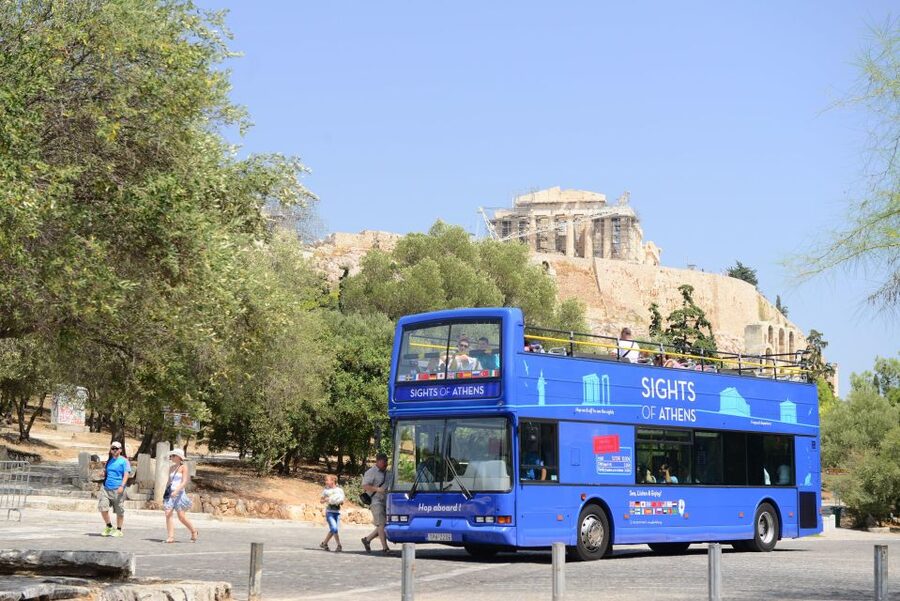
Yes, if you treat the pass as flexible sightseeing and transport rather than a timed private tour. The combination of Piraeus pickup, central Athens stops, and access to Glyfada and Vouliagmeni gives you far more range than a city-only loop.
Book it for the two-day flexibility, the low price, and the easy cruise-port connection. Plan carefully around traffic, check your terminal, confirm the last bus, and allow extra time for transfers. If you do that, this is a practical way to see the Acropolis, old Athens, the marinas, and the beaches in one compact ticket.
FAQ
How long is the ticket valid?
The ticket is valid for two days from first activation. It includes one ticket day and one complimentary day.
Which bus lines are included?
The ticket covers four lines: the Orange Line in Athens, the Blue Line in Piraeus, the Yellow Line to Glyfada, and the Green Line to Vouliagmeni.
Can I board at the Piraeus cruise port?
Yes. The Blue Line serves cruise Terminals A, B, and C at Piraeus Port.
Does the ticket include entry to the Acropolis or museums?
No. Admissions to attractions are not included, so you need separate tickets for the Acropolis, Acropolis Museum, and other sites.
What languages are available for the audio guide?
Recorded commentary is available in English, Spanish, Turkish, Chinese, Dutch, Finnish, French, German, Greek, Hebrew, Italian, Japanese, Arabic, Portuguese, and Russian.
Is the bus wheelchair accessible?
Yes. The buses have low-floor access and a designated wheelchair space. Free earphones and Wi-Fi are also provided, although Wi-Fi performance can vary between buses.
Just added around Athens
- Private Day Trip from Athens to Meteora by VIP Minibus★ 5.0 · 2 reviews
- PRIVATE Minibus Tour of Athens (by Piraeus Express)★ 4.0 · 13 reviews
- Hop-On Hop-Off Bus and Acropolis Museum Ticket★ 3.0 · 4 reviews
- From Athens: Small-Group Mycenae, Epidaurus & Nafplio Trip★ 5.0 · 187 reviews
- Meteora Full-Day Trip with Guide on Luxury Bus From Athens★ 3.5 · 3 reviews
- Athens Half Day Private Tour (up to 15 in a luxurious Mercedes Minibus)★ 5.0 · 4 reviews
- Pauls Biblical Ancient Corinth by Mini-bus★ 5.0 · 10 reviews
- Athens Combo Ticket: Full-Day Cruise and Hop on Hop off Bus★ 5.0 · 14 reviews
Athens Bus Tours, compared.

City Sightseeing Athens, Piraeus & Beach Riviera Hop-On Hop-Off Bus Tours
Read our review →

Hop on Hop Off Classic tour of Athens, Piraeus & Beaches
Read our review →
Big Bus Athens Hop-On Hop-Off with optional Piraeus & Riviera
Read our review →
Athens Shore Excursion: Athens and Piraeus Hop-On Hop-Off Bus Tour
Read our review →
City Pass with Acropolis, Museums, Hop-On Hop-Off Bus
Read our review →
Hop-on-Hop-off Bus and Cape Sounion Sunset Tour
Read our review →Browse the lists this tour appears in