
REVIEW · FRANCE
Visit Avignon and Villeneuve lez Avignon aboard a Double-Decker Bus
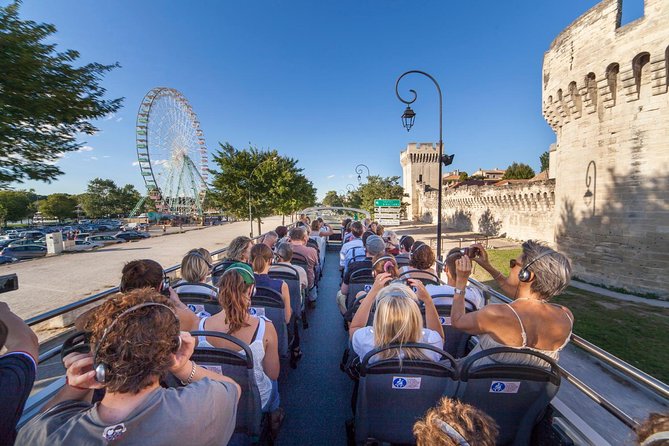
Avignon’s double-decker bus is most useful as a big-picture tour, carrying you beyond the famous city walls and across the Rhône into Villeneuve lez Avignon. You’ll see the broken Pont Saint-Bénézet, royal defenses, former cardinals’ homes, and the broad view back toward the Palais des Papes.
I like the clean, high-quality coach and the route across two Rhône bridges. I also like the chance to see places that are easy to miss on foot, especially Fort Saint-André and Barthelasse Island. The main drawback is that this is not always a classic hop-on hop-off service, and the route can feel rushed in traffic.
At a glance
- See two sides of the Rhône: The bus links Avignon with Villeneuve lez Avignon and crosses the river by different bridges.
- Hear English commentary: The main tour uses onboard audio rather than a traditional guide walking with you.
- Visit the outskirts without much effort: The route reaches Fort Saint-André, the Philippe le Bel Tower, and Barthelasse Island.
- Allow extra time for paid sights: Admission to Pont Saint-Bénézet and the Chartreuse de Villeneuve lez Avignon is not included.
- Watch the operating schedule: Service problems have occurred when the bus was booked for a Sunday or Monday, so confirm the running day before you set out.
- Expect a small-group-to-coach experience: The maximum capacity is 73 people, with a paper ticket and English service.
What this Avignon bus tour actually gives you
At about $16.30 per person, this is a reasonably priced orientation ride, not a full guided day of sightseeing. The advertised duration ranges from one hour to a full day because the service can function as a loop with stops, rather than as one fixed ride from start to finish.
That distinction matters. If you stay aboard for a single circuit, you can see the main route in roughly an hour or a little longer. If the timetable allows you to get off, visit a site, and board again, you can turn the ticket into a longer outing. But the practical details are not as clear as they should be.
Several parts of the route are genuinely useful. The bus skirts Avignon’s fortifications, crosses the Rhône, and reaches Villeneuve lez Avignon, giving you a sense of how the two towns relate to each other. You also get a look at the green expanse of Barthelasse Island, something you might otherwise miss during a short stay.
I would think of the ride as a way to get your bearings fast. It is less suitable if your main goal is a slow, photo-friendly trip through the historic center. The bus can move quickly, and traffic may consume a large part of the one-hour circuit.
More Open-Top Bus Tours in France
- Paris: Big Bus Panoramic Night Tour by Open-Top Bus
★ 4.4 · 4,168 reviews - Ajaccio: Town Highlights and Coast Open-Top Bus Tour
★ 4.3 · 1,523 reviews - Paris: Tootbus Open-Top Christmas Bus Tour
★ 4.0 · 1,365 reviews
Starting at 40 Cours Jean Jaurès
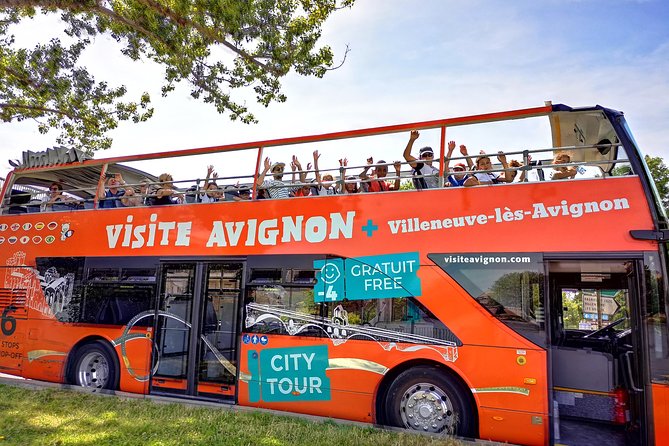
The stated meeting point is 40 Cours Jean Jaurès in Avignon, with the ride returning there. This is close to public transportation, which makes it a practical starting point if you arrive without a car.
Take care with the exact boarding location. The posted stop information has caused confusion, and one passenger waited at a map location that turned out to be wrong. I would confirm the stop with the operator before the day of the ride and allow extra time to find the bus.
The ticket is a paper ticket. Confirmation is issued when you book, and the service is offered in English. The maximum group size is 73, so this is a proper sightseeing coach rather than a tiny minibus for a handful of people.
The bus is described as clean and well maintained. You can choose an upstairs seat for a higher view, though the ride may feel fast when you are trying to photograph a monument. Audio connections have not always worked at every seat, so tell the driver promptly if you cannot hear the commentary.
Pont Saint-Bénézet and the story of the broken bridge
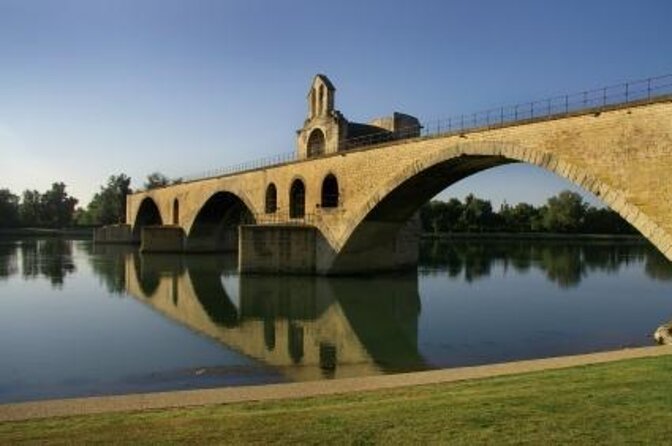
The first major sight is Pont Saint-Bénézet, better known as the Pont d’Avignon. The bridge is famous around the world because of the song about dancing on it, but the real structure is more dramatic than the tune suggests.
Construction began in 1177. The original bridge stretched about 920 meters and had 22 arches, making it one of the great engineering projects of its age. It was built in only eight years, but war and the Rhône took their toll. After the siege of 1226, the bridge was rebuilt, and later floods and neglect left only four arches standing.
In the Middle Ages, this was a key link on the pilgrimage route between Italy and Spain. Once the papal court moved to Avignon in the 14th century, the bridge became an important connection between the walled city and the residences that cardinals built in Villeneuve.
The small chapel on the bridge is linked to Saint Bénézet. Popes reportedly stopped there to pray and leave an offering. The bridge was paved in 1377 after repeated slips caused accidents and drownings. Louis XIV was among the last kings to cross the Rhône here before the bridge fell into its present ruined form.
The bus gives you the setting and the story, but the admission ticket is not included. If you want to walk on the bridge and see the chapel closely, plan that as a separate visit. From the bus, you get the best sense of the bridge’s relationship to the river and the city walls, but not the full experience of standing on its surviving arches.
The Lambert Collection and Avignon’s modern side
The route also passes the Lambert Collection, a modern art museum housed in an 18th-century mansion. It opened in 2000 during Avignon’s year as European Capital of Culture, after collector and gallery owner Yvon Lambert placed his personal collection there.
The collection began with about 350 works from the 1960s onward and later grew to more than 1,200 pieces. The museum includes exhibition rooms, conservation areas, activities for young people, a bookstore with artists’ editions, and a restaurant in the courtyard.
This is an interesting contrast to Avignon’s medieval monuments. The bus does not turn the museum into a full visit, so you should treat it as a landmark to note for later. If modern art interests you, the bus can help you locate it without spending time searching through the old streets.
Same city, a different seat on the bus:
- Paris: Tootbus Hop-on Hop-off (Optional River Cruise)
★ 4.3 · 15,279 reviews - Paris: Big Bus Hop-On Hop-Off Tour with Optional Cruise
★ 4.4 · 13,279 reviews - Paris Big Bus Hop-On Hop-Off Tour with Optional River Cruise
★ 4.0 · 6,534 reviews - Paris: Hop-On Hop-Off Seine Cruise Pass with 9 Stops
★ 4.4 · 5,645 reviews
Crossing to the Philippe le Bel Tower
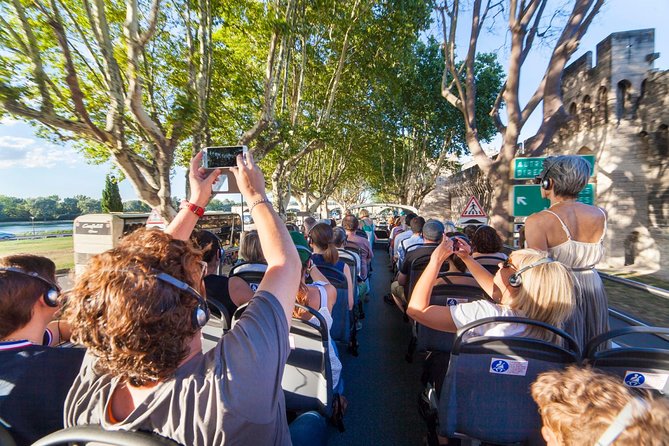
After leaving Avignon, the route heads toward the Philippe le Bel Tower in Villeneuve lez Avignon. Built in the 13th century by King Philippe le Bel, the tower controlled access to the Pont d’Avignon from the royal side of the Rhône.
It is a strong reminder that Avignon was not the only power center here. The papacy controlled the city on one bank, while the French crown guarded its interests on the other. The tower’s purpose was practical and political: control the bridge, monitor movement, and show royal authority.
The tower is a worthwhile exterior sight from the bus, though a quick pass does not give you much time to study the medieval construction. If you want detailed views, check whether your schedule allows a separate visit. The main value here is seeing how the bridge, river, and opposing fortifications fit together.
Fort Saint-André and the gardens of the abbey
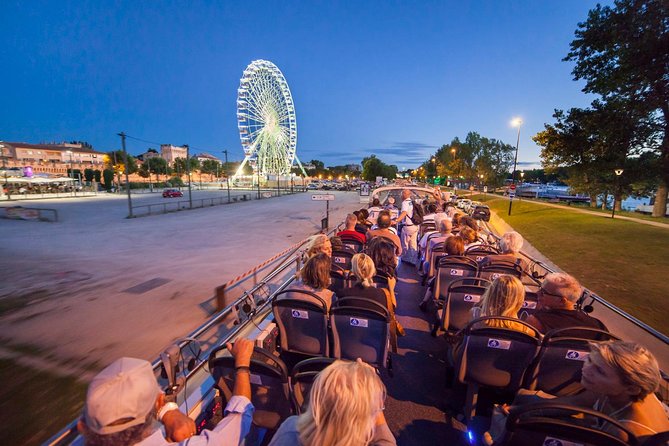
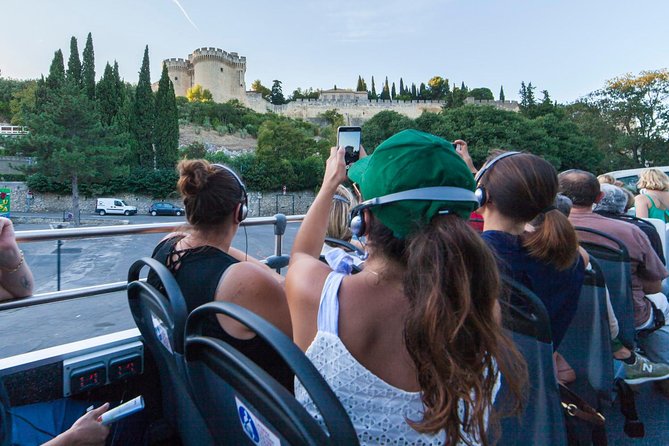
Fort Saint-André is one of the strongest stops on the Villeneuve side. Construction began at the end of the 12th century, and by the 14th century the fort protected the Benedictine abbey of the same name.
The fort shows why Villeneuve was more than a quiet suburb. It was part of the defensive system around the Rhône and a royal counterweight to papal Avignon. From this side of the river, the political geography becomes much easier to understand.
Admission to the fort is listed as free for this experience. The nearby Abbey of Saint-André adds a gentler note, with vaulted rooms decorated in the 17th century and gardens recognized with the Remarkable Gardens label.
The gardens combine Romanesque remains, Renaissance Tuscan-style ornament, rose beds, and Mediterranean plants. This is one of the better reasons to get off the bus if the timetable gives you enough time. The setting offers a break from traffic and a fine view toward Avignon.
Do not assume that every stop provides a long pause. The route is designed to connect several places, not to give you a leisurely garden visit at each one. Check the return times carefully before leaving the bus.
Chartreuse de Villeneuve lez Avignon
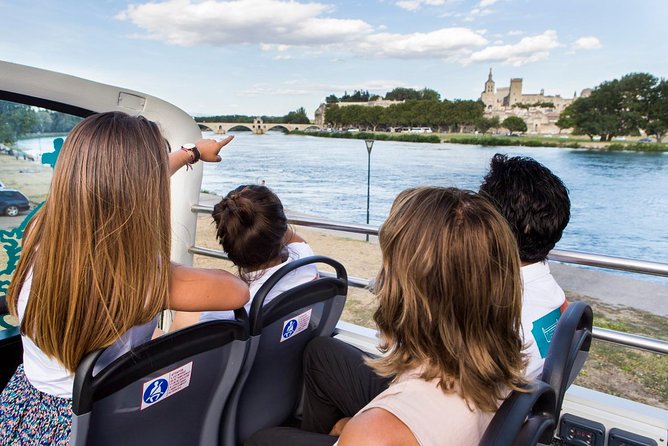
The Chartreuse de Villeneuve lez Avignon, also called the Chartreuse of the Val de Bénédiction, was built from 1353 under the direction of Pope Innocent VI. It served as a cardinal’s residence and reflects the influence of the papal court across the river.
The complex is more than one grand building. Its identity comes from the religious rooms, former residences, courtyards, and the sense of a secluded place built for powerful church officials. A mansion dating from the 14th century is also linked with several cardinals who lived here.
Admission is not included. That makes this stop better for people who want to add a paid historical visit rather than simply ride past. If you only have an hour, stay on the bus and use the audio commentary for orientation. If you have most of a day, the Chartreuse can help turn the bus ride into a fuller Villeneuve excursion.
Barthelasse Island and the best wide view
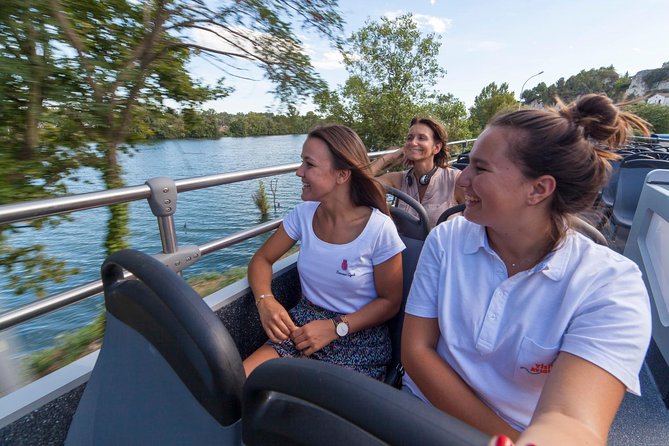
The final major stop is Île de la Barthelasse, a 700-hectare green area in the Rhône. The bus pauses for about 10 to 15 minutes, giving you time to relax and look back toward Avignon, the city walls, and the monuments often called the city of the Popes.
This is the most open view on the route. After the narrow streets and heavy stone of the historic center, the river and island give you room to see the whole arrangement at once.
The stop is short, so use it for the view rather than trying to fit in a separate activity. The information also mentions a free river shuttle, which can take you toward the historic center, and the possibility of continuing by bicycle. Those options may be useful if you want to make the island more than a quick photo stop, but the bus ticket itself does not promise a bike excursion.
Audio commentary, speed, and comfort
The bus uses English audio commentary. That is helpful when the route moves through several neighborhoods and across the river, since you can learn what you are seeing without a guide standing beside you.
The audio quality appears to depend on the individual seat connection. If your headset does not work, tell the driver immediately and ask for another audio unit. Do not wait until the loop is over.
The ride is generally described as clean and comfortable, and the large coach gives you a broad view of the surrounding area. The tradeoff is speed. Some sections can pass too quickly for photographs, and traffic may take up at least half of a short circuit.
This is not the best format for detailed architectural study. It is better for orientation, river views, and deciding which places deserve your time later.
Is $16.30 a fair price?
The value depends on how you use the ticket. At $16.30, a single circuit is fair if you want an efficient look at Avignon, Villeneuve, and Barthelasse Island without arranging separate transportation.
The price becomes better if the service genuinely allows you to get off, visit a site, and continue later. But you should not assume unlimited hop-on hop-off freedom. The route has been described as less flexible than a traditional city bus, and one passenger completed a loop and left because the stops did not suit a normal hop-on hop-off plan.
Paid admissions are extra at Pont Saint-Bénézet and the Chartreuse. The fort and Barthelasse Island are listed without an admission charge, but the bus does not replace a full visit to each site.
For a family, an older person, or anyone who wants to avoid a long walk between Avignon and Villeneuve, the price may be worthwhile. For a strong walker who already knows the city, a short ride may feel expensive if traffic slows the circuit and you remain on board the whole time.
Who should book this ride?
I would recommend it to you if you want to see the relationship between Avignon and Villeneuve before choosing where to spend the rest of your day. It also suits you if you enjoy audio tours, prefer a high view from a coach, or have limited mobility for long distances.
It is especially useful for a first look at the area around the city walls, the Rhône crossings, Philippe le Bel Tower, Fort Saint-André, and Barthelasse Island. The route reaches places that are not part of a simple walk around the Palais des Papes.
I would be cautious if you need a guaranteed Sunday or Monday departure, a detailed live guide, or a perfectly clear hop-on hop-off schedule. The service has not always operated on Sundays and Mondays, even when a booking was accepted, and the timetable information has caused frustration.
The experience also requires good weather and a minimum number of participants. If poor weather or low demand cancels the ride, you are offered another date or experience, or a full refund. You can cancel for a full refund up to 24 hours before the start time, but later cancellations and changes are not accepted.
My verdict on the Avignon double-decker bus
Book this if you want a quick, affordable orientation beyond central Avignon. The clean coach, English audio, Rhône crossings, and wide view from Barthelasse Island are the strongest points. The route also gives you a useful look at Villeneuve’s royal and cardinal history.
Skip it if you are expecting a polished hop-on hop-off system with frequent buses, exact map pins, and generous photo pauses. Before paying, confirm the operating day, meeting point, departure time, and the rules for leaving and rejoining the bus.
Used as a sightseeing introduction, it can save your legs and help you plan. Used as a complete substitute for visiting Avignon’s monuments, it will feel thin. The best approach is to take the circuit early, note the places that interest you, then return on foot or by local transport for the visits that deserve more time.
FAQ
Where does the double-decker bus tour start?
The stated meeting point is 40 Cours Jean Jaurès, 84000 Avignon, France. The activity ends back at the same meeting point.
How long does the experience last?
The listed duration ranges from about one hour to one day. A single loop takes roughly an hour or a little longer, while a longer visit may be possible if you get off at stops and continue later.
Is the tour offered in English?
Yes. English audio commentary is provided on the bus.
Are entrance fees included?
No. Admission to Pont Saint-Bénézet and the Chartreuse de Villeneuve lez Avignon is not included. Fort Saint-André and Île de la Barthelasse are listed with free admission.
Is this a traditional hop-on hop-off tour?
Not consistently. The route includes several stops, but the service may not operate like a frequent hop-on hop-off network. Confirm the timetable and reboarding rules before leaving the bus.
Does the tour operate every day?
The supplied information does not guarantee daily operation. Service has not operated on some Sundays and Mondays, so confirm the running schedule for your chosen date.
What is the cancellation policy?
You can cancel at least 24 hours before the start time for a full refund. Later cancellations or changes are not accepted. Poor weather or failure to meet the minimum number of participants may result in another date, another experience, or a full refund.
Just added around France
- Private Tour of Epernay and Vineyards by Bus with Champagne★ 5.0 · 7 reviews
- Épernay and Champagne Open-Top Bus Tour with 3 Tastings★ 5.0 · 11 reviews
- City Tour in Cannes aboard our Classic French Bus!★ 5.0 · 109 reviews
- Explore Cannes Countryside in Style with our Classic Bus Tours!★ 5.0 · 2 reviews
- Cannes Large Group Shore Excursion with a Minibus 15 seater★ 5.0 · 3 reviews
- Visit of Antibes Juan-Les-Pins by convertible bus★ 3.5 · 24 reviews
- Tour of Annecy by convertible bus★ 4.1 · 92 reviews
- Paris: Louvre Museum Access with Host and Hop-On Hop-Off Bus★ 3.6 · 20 reviews
France Bus Tours, compared.

Tootbus Hop-on Hop-off (Optional River Cruise)
Read our review →
Paris Big Bus Hop-On Hop-Off Tour with Optional River Cruise
Read our review →
Hop-On Hop-Off Seine Cruise Pass with 9 Stops
Read our review →
Paris Seine River Hop-On Hop-Off Sightseeing Cruise by Batobus
Read our review →
Paris Tootbus Hop-On Hop-Off Bus Tour (Optional Cruise)
Read our review →
Hop-on Hop-off Bus Tour & Seine Cruise Bundle Tour
Read our review →
Marseille: City Sightseeing Hop-On Hop-Off Bus Tour
Read our review →Browse the lists this tour appears in