
REVIEW · GERMANY
Munich: Big Bus Hop-On Hop-Off Tour by Open-Top Bus
Munich’s blue open-top bus gives you a quick handle on a city that spreads well beyond its postcard center. You can circle the main sights in about 2.5 hours, then hop off at Marienplatz, Nymphenburg Palace, Olympiapark, or the BMW complex when something catches your eye. It is especially useful on a rainy day, when sitting upstairs with a roof overhead may be far easier than walking between distant sights.
I like the flexible 24 or 48-hour ticket and the two routes, which reach places you would not cover easily on foot. I also like the audio commentary, offered in nine languages, because it supplies useful background while you watch Munich pass by. The main catch is timing: the Orange Line runs less often, and the buses generally stop early enough that you may not have time for several long visits in one day.
Key points to know before boarding
- Start at Karlsplatz: Stop 1, next to the Buddy Hotel, is the clearest place to activate your mobile voucher.
- Choose your route carefully: The central Green Line runs daily, while the Orange Line reaches Nymphenburg, BMW Welt, Olympiapark, and Schwabing.
- Allow 2.5 hours for a full circuit: That is the ride time if you stay onboard without getting off.
- Use the audio guide for context: Commentary comes in English, German, Spanish, Italian, Japanese, Chinese, Portuguese, Russian, and French.
- Plan around service gaps: The Orange Line runs every 30 minutes on weekdays and every 20 minutes on weekends, subject to seasonal changes.
- Check the Deutsches Museum stop: It is temporarily suspended because of construction work.
Why this bus works well in Munich
Munich is easy to explore in the center, but its major sights are spread out. Marienplatz, the Pinakotheken, Nymphenburg Palace, Olympiapark, BMW Welt, and the English Garden do not form one tidy walking route. This bus connects them without asking you to keep figuring out public transport.
At about $27 per person, the tour is best viewed as both transportation and sightseeing. A 24-hour ticket can work well if you use it to cover the full circuit first, then get off at one or two places. The 48-hour option gives you more breathing room, particularly if you want to spend real time at a museum, palace, or the Olympic Park.
I would not buy it simply to sit on a bus all day. The value comes from using the bus as a moving introduction to Munich and as a ride between outlying sights. If you only want Marienplatz, Viktualienmarkt, and the old town, walking may be cheaper and more rewarding.
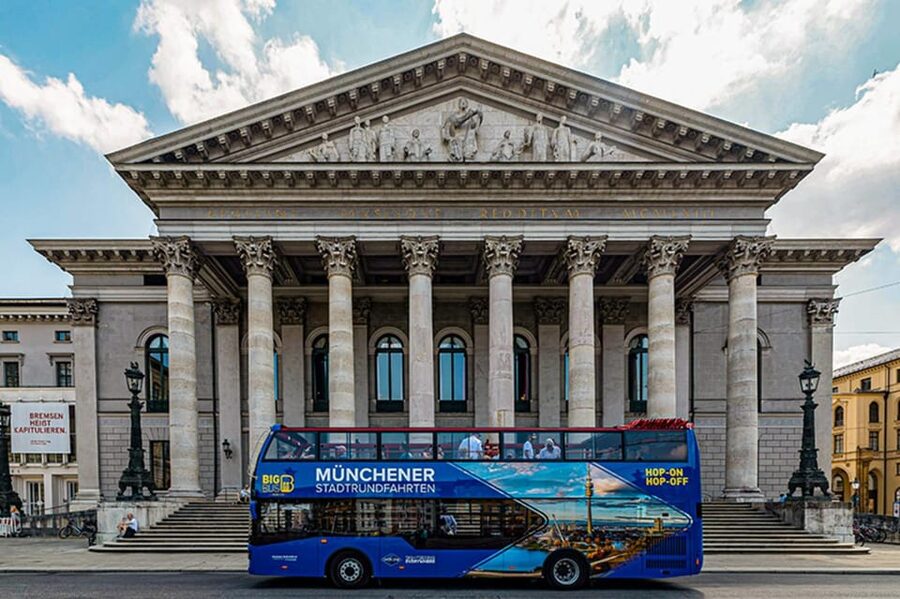
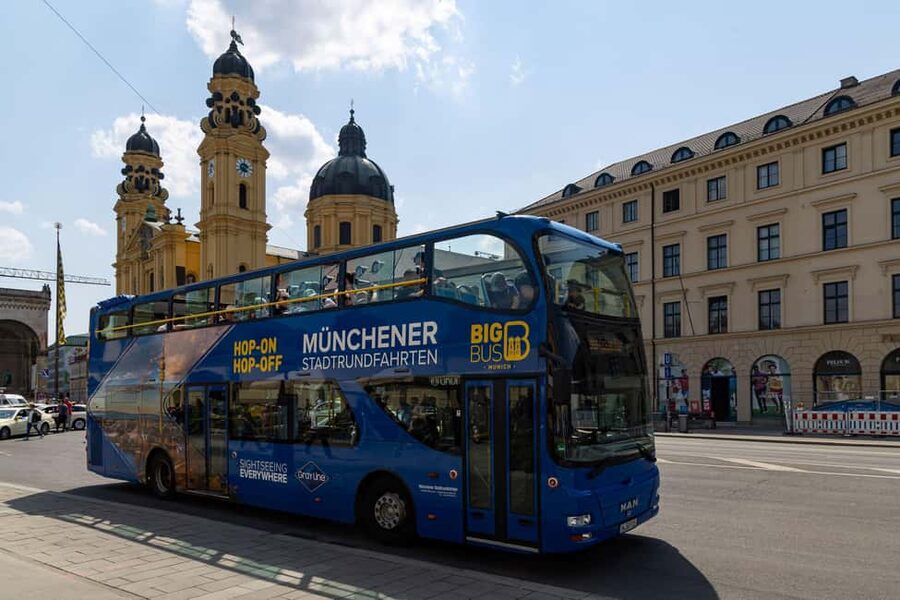
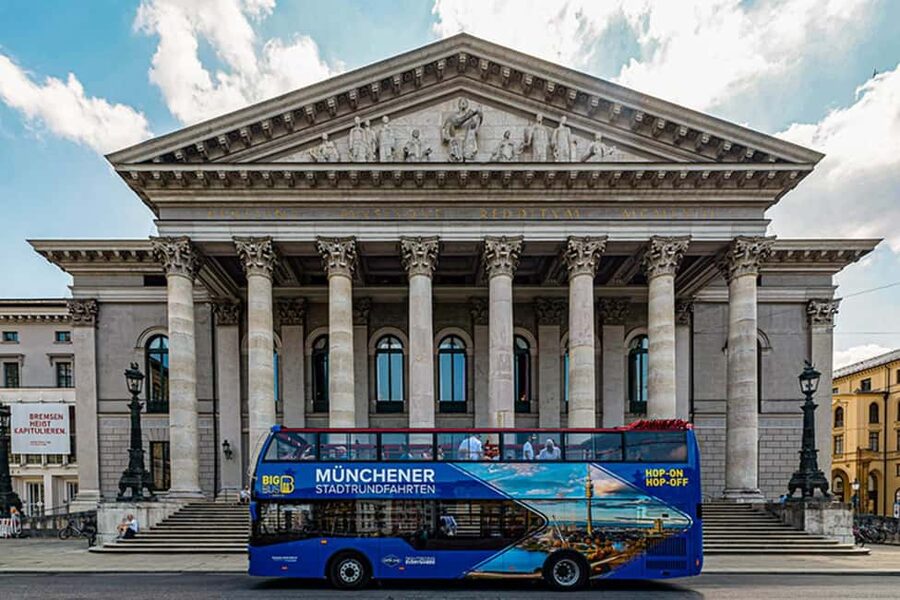
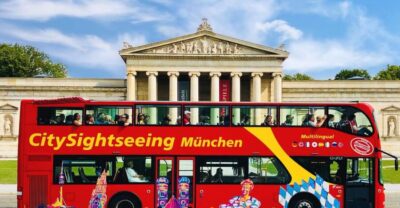
The buses are blue, open-top double-deckers. On a sunny day, the upper deck gives you a broad view of streets, buildings, and parks. On cold or rainy days, the retractable roof and covered seating make the ride more practical, though winter weather can still make a long ride chilly.
More Hop-On Hop-Off Bus Tours in Germany
- Berlin: Hop-on Hop-off Bus Tour with Live Commentary
★ 4.3 · 8,579 reviews - Hamburg: Line A Sightseeing Hop-On Hop-Off Bus Tour
★ 4.6 · 6,958 reviews - Berlin: Big Bus Hop-On Hop-Off Sightseeing Tour & Currywurst
★ 4.4 · 4,638 reviews
Starting at Karlsplatz and seeing Munich’s center
Stop 1 is at Karlsplatz 21, beside the Buddy Hotel. This is the recommended starting point because it is easy to find and gives you a clear beginning and end point for the circuit. You can also board at other stops, but first-time visitors may find Karlsplatz less confusing than trying to locate a bus somewhere along the route.
Karlsplatz, also called Stachus, is one of Munich’s main urban squares. From here, the bus takes you through the pedestrian shopping area and toward the central sights. A stop here makes sense if you want shops, a quick orientation, or a place to begin walking.
The bus then passes the Kunstareal, Munich’s museum district. The Pinakotheken are the main architectural and cultural markers here, with the Alte Pinakothek particularly important for European art. The bus does not replace a museum visit, but the audio track helps you understand why this part of town matters.
At Odeonsplatz, look for grand buildings and an important city square with strong connections to Munich’s royal past. This is a good place to hop off if you want to continue on foot toward the Residenz area, the Theatinerkirche, or the English Garden. The tour only gives you an outside view, so plan separate time if you want to enter any of these sights.
The Eisbach stop is useful for the English Garden and its famous standing wave. You may see surfers riding the fast-moving water beside the park road. That spectacle takes only a short time to watch, while the park itself deserves a longer walk if the weather is good.
Marienplatz, Viktualienmarkt, and the old town
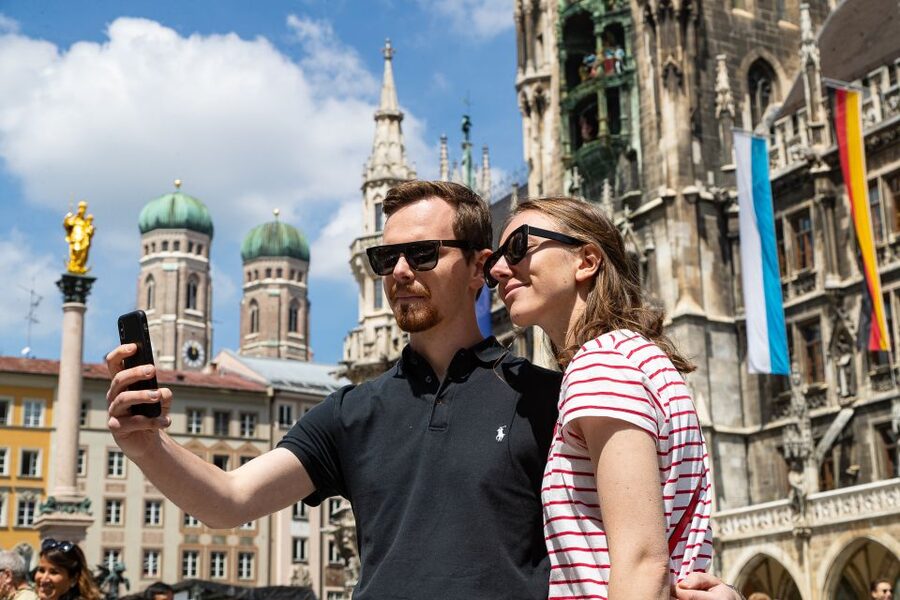
The route passes Marienplatz, Munich’s central square and the place most visitors want to see first. The Neues Rathaus dominates the square, and the area gives you an immediate sense of the city’s medieval center, even though much of what you see today was rebuilt after wartime damage.
Hop off at Marienplatz and you can walk to the Viktualienmarkt, a food market filled with produce stands, snacks, cheeses, sausages, and local specialties. It is a better place for a quick taste of Munich than a formal meal if your schedule is tight. Give yourself time to browse rather than treating it as a passing photo stop.
The nearby Hofbräuhaus is another familiar Munich name. The bus does not provide a reserved table or meal, so you will need to visit independently. If you want the full beer-hall setting, allow time after getting off at Marienplatz or Tal.
Max-Joseph-Platz provides another useful central stop. From there, you can reach the Residenz, the Bavarian State Opera, and elegant streets around the royal quarter. The bus is helpful for spotting these areas, but the audio commentary cannot give you the same detail as a proper interior visit.
One practical point matters here: the audio can occasionally fall out of step with what you are passing. If you want to match every comment to every building, sit where you can see clearly and keep an eye on the route map. The commentary is informative, but it is not the same as having a guide point out a detail in real time.
The Orange Line to Nymphenburg Palace
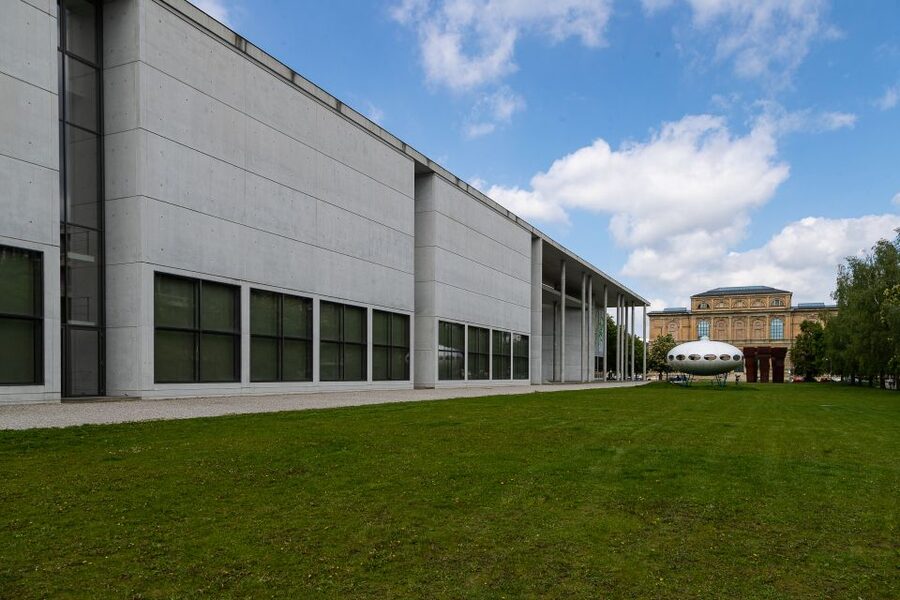
The Orange Line is the route for Munich’s grander, more distant sights. It takes about 80 minutes as a complete circuit, without counting time spent off the bus. Service is every 30 minutes Monday through Friday and every 20 minutes on weekends, though schedules can change with the season.
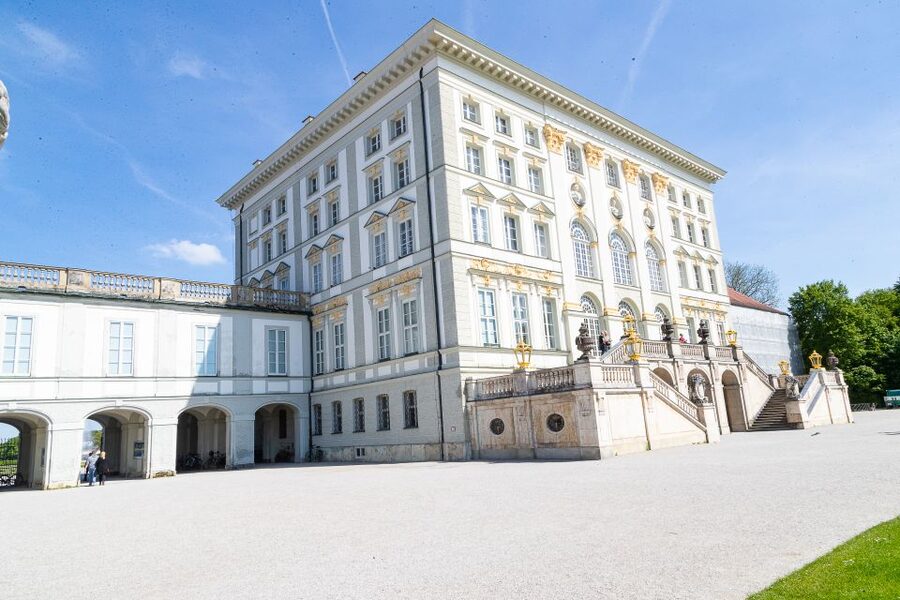
Nymphenburg Palace is the first major reason to choose this route. The former royal residence has formal buildings, gardens, and broad grounds that feel very different from the tight streets of the old center. You can get off here for a palace visit or a walk through the gardens.
Do not plan Nymphenburg as a quick ten-minute stop. The palace and grounds need time, and the next Orange Line bus may not arrive immediately. Check the live tracking in the Big Bus app before leaving the stop, especially if you are working with a 24-hour ticket.
The palace stop also shows why the tour can be good value for a first visit. A taxi or separate public transport trip to Nymphenburg adds another decision to your day. Here, you can stay on the sightseeing route and keep the palace connected to the rest of your Munich plan.
More Open-Top Bus Tours in Germany
- Berlin: Live-Guided Evening Sightseeing Tour by Open-top Bus
★ 4.1 · 783 reviews - Hamburg Hop-on Hop-off Sightseeing Tour on Red Double Decker Bus
★ 3.5 · 409 reviews - City tour of Hamburg in a double-decker bus Hopp on / Hopp off day ticket
★ 3.0 · 40 reviews - Hamburg: Hop-On Hop-Off Bus Tour Yellow Double Decker
★ 4.8 · 25 reviews
Olympiapark and BMW Welt
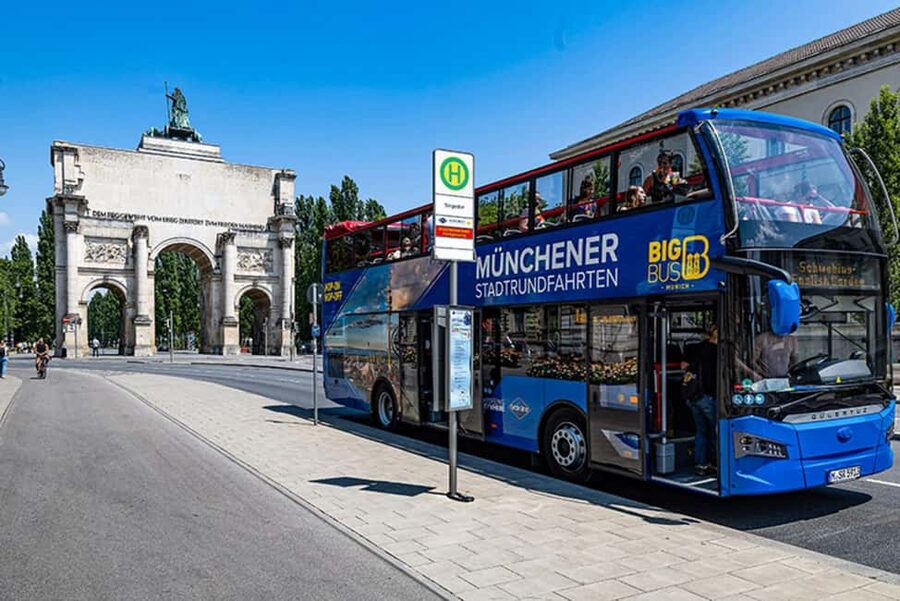
The Orange Line continues to Olympiapark and BMW Welt and Museum. This part of the route offers some of Munich’s most distinctive modern sights, in contrast to the palace façades and old-town squares downtown.
Olympiapark was built for the 1972 Olympic Games and is known for its sweeping roof structures and open recreational areas. From the bus, you get a useful overview. If you get off, you can walk around the park and take in the architecture at a slower pace.
BMW Welt sits beside the BMW Museum. The distinction matters: BMW Welt is a modern exhibition and visitor space, while the museum focuses on the company’s vehicles and development. The listing includes the route past both, but admission to a museum or special attraction is not included in the bus ticket.
This stop is a strong choice for car enthusiasts, families, and anyone who has already covered the old town. It is less useful if your Munich visit is very short and your main goal is historic architecture. Also watch the bus clock. A delayed return can cost you a large part of the afternoon, and one past schedule report involved a bus arriving later than expected at BMW Welt.
Schwabing and the English Garden
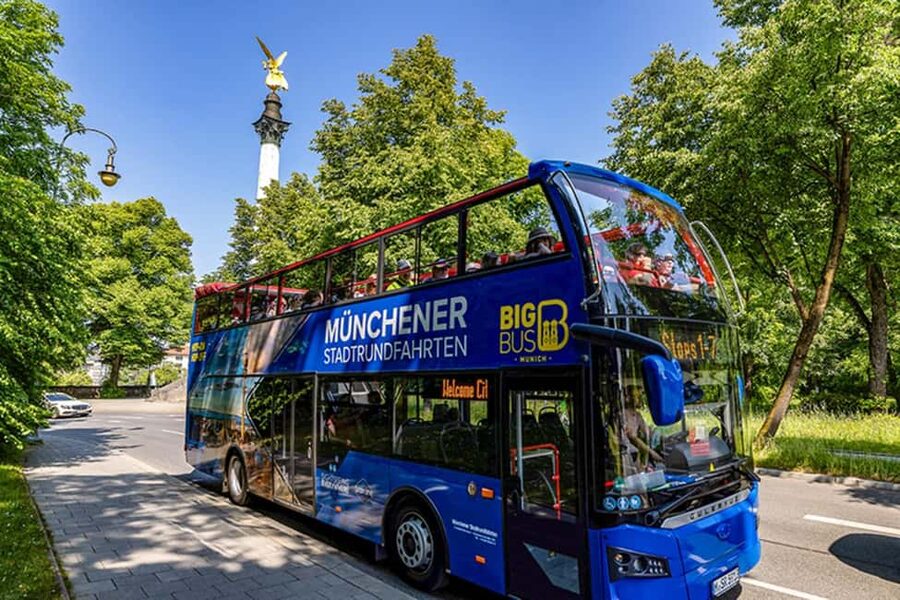
The Orange Line passes through Schwabing, a district associated with cafés, shops, and Munich’s arts scene. You can get off to browse, then continue toward the English Garden. The route gives you a taste of the area, but it cannot cover every side street or local café.
The English Garden is one of the best places to turn a bus tour into a walk. The Eisbach wave is near the southern end, while the park itself stretches much farther. You can make this a short stop for the surfers or use it as a longer break from the bus.
I would pair Schwabing or the English Garden with the Eisbach stop rather than trying to visit every central stop in one sweep. The bus gives you access, but Munich’s parks and neighborhoods reward slower movement. Just confirm the next departure before wandering too far.
Green Line or Orange Line?
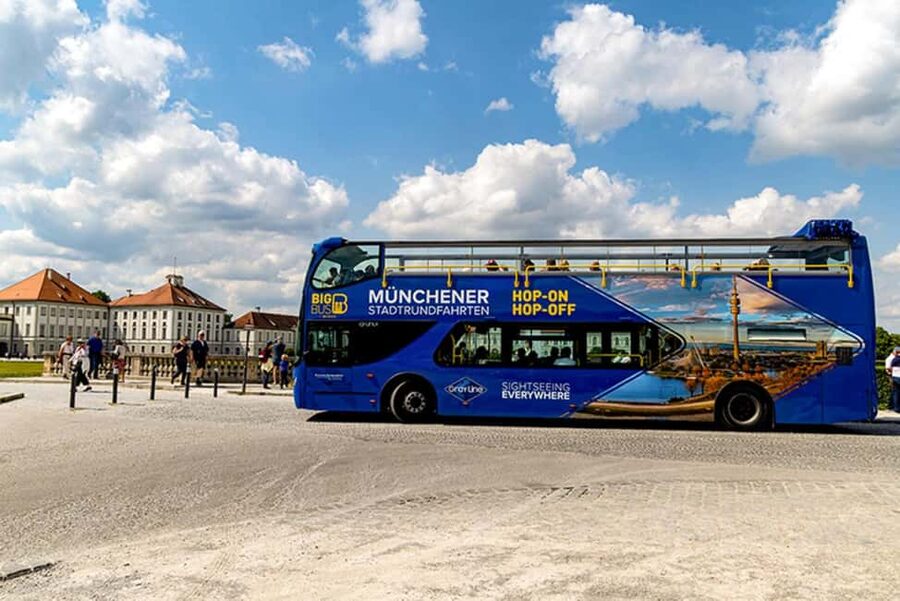
The central route, described as the Green Line, runs daily and takes about 60 minutes. It focuses on the central sights, including Karlsplatz, the museum district, Odeonsplatz, Eisbach, Marienplatz, and Max-Joseph-Platz.
The Orange Line takes about 80 minutes and reaches Nymphenburg Palace, Olympiapark, BMW Welt and Museum, and Schwabing. It runs less often on weekdays, so a missed bus has a bigger effect on your schedule.
Some booking details have made the two-loop arrangement confusing for passengers, particularly around upgrades or access to both routes. Check exactly what your selected ticket covers before paying. If you want Nymphenburg and BMW as well as the old town, confirm that both lines are included.
A sensible plan is to ride the central route first for orientation. On the second day, use the Orange Line for one or two major stops. Trying to visit Marienplatz, Nymphenburg, BMW, Olympiapark, and the English Garden in one day will leave you rushing.
Audio commentary, staff, and comfort

The audio guide is included, and headphones are provided onboard. You can listen in nine languages: English, German, Spanish, Italian, Japanese, Chinese, Portuguese, Russian, and French.
The commentary gives you useful background on buildings and districts, which makes the ride more than a simple transfer. It is also handy when you are riding in poor weather and want to see Munich without spending hours outdoors.
The German and English service may also be live from the driver or guide on some departures, while other languages use the recorded audio. One earlier guide, identified as Wolf or Rolf, was praised for combining city knowledge with dry humor. Do not count on a particular guide appearing on your departure, but the possibility of a live, personable presentation adds warmth when it happens.
The main weakness is that recorded audio cannot react to traffic or point out an unexpected detail. One useful improvement would be a display synchronized with the commentary. For now, the Big Bus app helps with live tracking, stops, and updates, while the audio handles the historical explanation.
WiFi is included. Wheelchair users can use the accessible buses, and dogs are welcome. Infants aged three and under ride free and do not need a ticket.
Timing, weather, and practical value
The ticket is valid for 24 or 48 hours from first use, not from the time you book. Activate the mobile voucher or QR code when you board at any Big Bus stop. Look for the blue double-decker bus or ask for Münchener Stadtrundfahrten.
The biggest practical limit is the operating day. The service may not run late enough for a long summer evening, even when daylight continues well past the final departure. If you plan dinner, evening drinks, or a late museum visit, treat the bus as daytime transport.
Bad weather does not automatically ruin the experience. The bus can save a wet day when walking between Munich’s sights would be unpleasant. Still, the upper deck is best reserved for dry weather, and a covered seat is the safer choice when rain or cold sets in.
Free cancellation is available up to 24 hours before departure, and you can reserve now and pay later. Those terms are useful if your arrival time is uncertain, but they do not solve the route and timetable questions. Check the day’s schedule before you commit to a distant stop.
Should you book the Munich Big Bus tour?
Book it if you have one or two days in Munich, want a broad first look, or plan to combine the old town with Nymphenburg, BMW Welt, Olympiapark, or the English Garden. It is also a sensible choice for anyone who wants less walking, needs wheelchair-accessible transport, or arrives during unsettled weather.
Skip it if you are staying in the center and prefer to explore on foot. Families should compare the total price carefully because several adult fares can add up, and the early finish may limit the value of a 24-hour ticket.
My best use of the tour would be a first ride on the central route, followed by one carefully planned Orange Line outing. That approach gives you Munich’s main landmarks, useful orientation, and enough time to actually get off the bus and enjoy the places that interest you.
FAQ
How long does the full Munich bus route take?
The complete circuit takes about 2.5 hours if you remain onboard without hopping off. The Green Line itself takes about 60 minutes, and the Orange Line takes about 80 minutes.
How long is the ticket valid?
You can choose a ticket valid for 24 or 48 hours. Validity begins when you first use the ticket.
Where can I start the tour?
The recommended starting point is Stop 1 at Karlsplatz 21, next to the Buddy Hotel. You can also activate your mobile voucher or QR code when boarding at another Big Bus stop.
Which sights are on the Orange Line?
The Orange Line goes to Nymphenburg Palace, Olympiapark, BMW Welt and Museum, and Schwabing, with access to the English Garden.
Is the Deutsches Museum stop operating?
The Deutsches Museum stop is temporarily suspended because of construction work.
Is the bus accessible?
Yes. The buses are wheelchair accessible, dogs are welcome, and infants aged three and under travel free without a ticket.
Just added around Germany
- Hop-on hop-off on the water with the Maritime Circle Line in Hamburg★ 4.0 · 84 reviews
- Hamburg: Hop-On Hop-Off Tour – Yellow Double Decker★ 3.5 · 18 reviews
- Private Sightseeing Tour with our Minibus 8-seater★ 3.5 · 3 reviews
- Hamburg Hop-on-Hop-off Tour, Harbor and Lake Alster Cruise★ 3.5 · 97 reviews
- Best of Hamburg: City Sightseeing Hop-On Hop-Off Bus Tour★ 4.5 · 3 reviews
- Minibus-Tour von Frankfurt (Main) to Rothenburg (Tauber) – Abholung am Hotel★ 3.5 · 2 reviews
- 2 day ticket Grand City Tour Hop on Hop off 22 stops★ 3.5 · 38 reviews
- Sachsenhausen Concentration Camp Bus Tour★ 4.0 · 3 reviews
Germany Bus Tours, compared.
Big Bus Hop-On Hop-Off Sightseeing Tour & Currywurst
Read our review →
Munich Hop-On Hop-Off Tour: 1-Day or 2-Day Ticket
Read our review →

Browse the lists this tour appears in