
REVIEW · SHORE EXCURSIONS
Guided Antwerp Port Tour, in your Car or Minibus
Antwerp’s port is too large to understand from a river cruise or city walk. This private drive takes you past giant locks, chemical plants, container yards, and rail lines, then pauses at old Lillo, where geese wander beside 18th-century houses. It is a sharp lesson in how a medieval river city became one of Europe’s great freight hubs.
I like the way the tour joins big engineering with human stories. The Berendrecht Lock gives you brute scale, while Lillo Fort shows what port expansion displaced. I also like the guide-led approach, with room for questions instead of a fixed speech. The main drawback is practical: you must provide the car or minibus, and some stops are brief drive-bys rather than long visits.
Key points before you book
- Havenhuis and dry docks: Begin with Zaha Hadid’s glass-topped port headquarters and the old docks being converted into a Maritime Museum.
- Europe-sized infrastructure: See the Berendrecht Lock, Oosterweel construction works, and the working Boudewijn and Van Cauwelaert locks.
- Lillo’s sharp contrast: Walk around an old fortified village beside one of Europe’s largest chemical areas.
- A private format: Your group alone takes part, with space for up to 15 people.
- Your vehicle is required: The guide boards your car, coach, or minibus. Transport is not included.
- A guide with local feeling: Guides such as Laurens and Niki bring personal port experience and a conversational style.
Why Antwerp’s port deserves a dedicated tour
Antwerp’s historic center tells only half the city’s story. The port stretches far beyond the cathedral, with roads, docks, pipelines, rail yards, storage tanks, locks, and terminals spread across a huge area. From an ordinary sightseeing route, much of this working world remains out of reach.
This tour gives you a moving explanation of that system. You are not simply taken to one viewpoint, given a few numbers, and sent back. The guide connects each place to the next: ships enter through sea locks, goods move through terminals, chemicals travel through pipelines, and trains carry freight inland toward Germany, France, and the Ruhr.
The tour lasts about two and a half hours. That is long enough to cross a broad section of the port without turning the day into a full industrial field trip. Because it is private, the pace can feel more natural than a large coach tour. You can ask about a strange building, a ship, a pipeline, or a local story as you go.
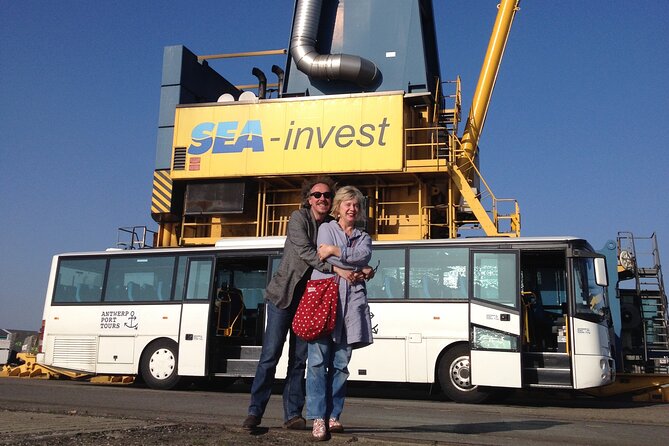
The meeting point is Kinepolis Antwerpen on Groenendaallaan. The tour ends back there, which makes planning easy if you are driving. An English-speaking guide accompanies the group, and the activity is offered by Antwerp Port Tours.
More Shore Excursions in Belgium:
- Corfu: Paleokastritsa Beach and Old Town Bus Shore Excursion
★ 4.3 · 704 reviews - Athens Shore Excursion: Athens and Piraeus Hop-On Hop-Off Bus Tour
★ 4.0 · 617 reviews - Shore Excursion: Barcelona City Tour Hop-On Hop-Off
★ 4.0 · 280 reviews
Havenhuis and the old dry docks
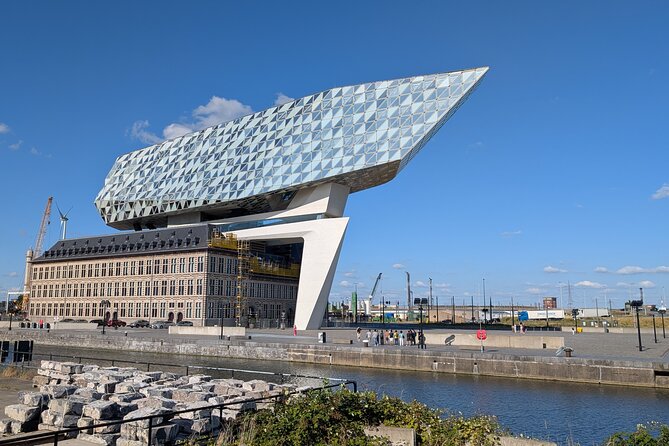
The first stop at Droogdokkenweg sets the tone. You get out near a quiet pier opposite the Havenhuis, Antwerp’s striking port headquarters designed by Zaha Hadid.
Its angular glass structure sits above a historic fire station, creating an unusual meeting of old masonry and modern design. From the pier, the building appears to float above the water. It is a good place for photographs, but the guide adds the useful part: an explanation of the design and the relationship between the building and the surrounding docks.
The dry docks beside you are also changing. They are being transformed into the city’s Maritime Museum, so this is not only a look at the port’s past. It is a glimpse at how Antwerp is presenting that past to future visitors.
You have about 10 minutes here. That is enough for a quick walk, photographs, and an introduction. It is not enough for a museum visit, since no admission visit is part of the tour. Think of it as a visual opening, not a long stop.
Oosterweel, where a medieval church meets a huge work site
The route then passes the small Oosterweel church, dating from the 15th century. Beside it, the Oosterweel works form a startling contrast. The construction area is described as Europe’s biggest wharf, where tunnel sections for Antwerp’s long-awaited Ring closure are being made.
This is one of the tour’s best examples of scale. A tiny river parish survives beside a huge modern infrastructure project. The guide explains how old communities along the Scheldt were followed by post-war port growth, then by today’s costly effort to reshape Antwerp’s road network.
You may only see this scene from the vehicle, so do not expect to wander around the construction area. Its value comes from the explanation and the contrast. It gives you a better sense of how the port keeps changing, even where old religious buildings remain.
Scheldelaan’s chemical works and graffiti wall
Along Scheldelaan, the vehicle becomes a viewing platform. On one side are storage tanks, processing towers, and steam rising from Europe’s second-largest chemical cluster. On the other is a long flood wall covered with large-scale graffiti from an international annual contest.
The contrast is unusually effective. The industrial side is about pipes, pressure, storage, and constant movement. The painted wall adds color and human expression to what could otherwise seem like a severe industrial corridor.
Your guide explains that pipelines run below the road like hidden arteries. That detail matters because it helps you understand that the port is not a collection of isolated buildings. The plants, terminals, roads, ships, and pipelines form one connected working system.
This part is primarily a drive. If you want long photo stops at every facility, you may find the pace quick. The benefit is that you cover more ground and see the industrial port as a whole rather than as a single viewpoint.
A few more bus tours around Belgium worth a look
- Milan: City Sightseeing Hop-On Hop-Off Bus with Audio Guide
★ 4.0 · 6,256 reviews - London: Christmas Lights Bus Tour With Live Guide
★ 4.0 · 5,410 reviews - From Madrid: Guided Day Trip to Toledo by Bus
★ 4.1 · 5,280 reviews - From NYC: Guided Day Trip to Washington DC by Van or Bus
★ 4.7 · 3,418 reviews
The Boudewijn and Van Cauwelaert locks
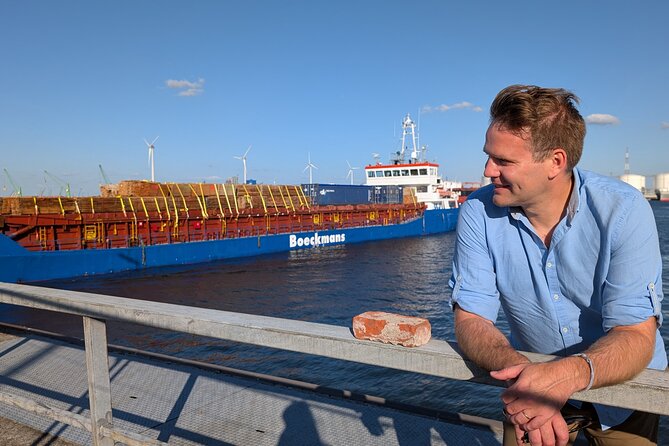
At Boudewijnsluis, you leave the vehicle beside the De Vaarkom basin. The Boudewijn and Van Cauwelaert locks are smaller than the giant sea locks later in the tour, but they do essential work for barges and short-sea cargo ships.
The guide points out lock-master signals, tug activity, and the water movement caused by bow thrusters. These details turn a technical operation into something you can watch and follow. Instead of simply seeing a ship pass through a gate, you learn why the locks matter to refinery supplies and daily port traffic.
This is another 10-minute stop. That may sound short, but the tour has many locations to cover. A brief pause works here because the guide can explain the basic process while you watch vessels and tugs. If lock operations are active during your visit, the stop becomes much more engaging.
Lillo Windmill and the port’s lost villages
The route continues toward Lillo, passing a lone brick windmill along Scheldelaan. It once served the village of Lillo, and today it acts like a marker for what the expanding port absorbed.
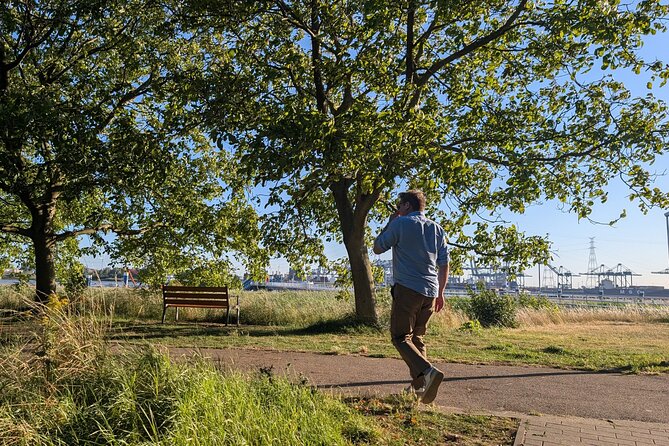
The guide uses the windmill to explain the port’s vast reach. After roughly 30 kilometers of road travel, you are still only about halfway through its territory. That single fact is useful. It corrects the common idea that Antwerp’s port is just a strip of quays beside the city.
You also hear about hamlets that were bought out and dismantled as docks moved inland. Some residents left, while others resisted for as long as they could. This gives the port a human side without turning the tour into a sentimental story. Expansion brings jobs and trade, but it also changes communities and erases familiar places.
The windmill is a drive-by, so keep your eyes ready. You will not get the same amount of time here as at Lillo Fort.
Berendrecht Lock and the doorway to the outer docks
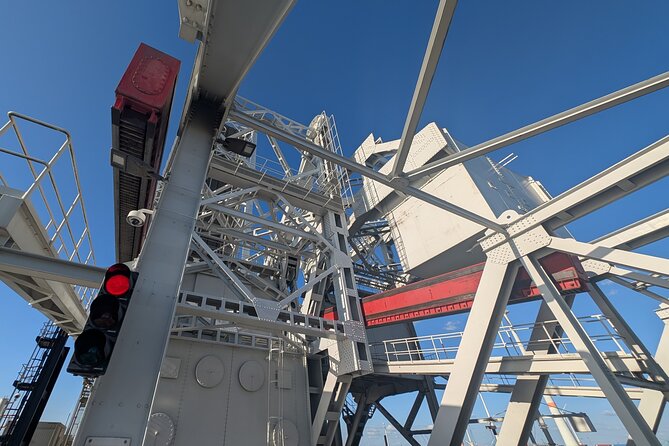
The Berendrecht Lock is one of the tour’s major sights. From the service road, you can see one of the world’s largest sea locks, a key route into the docks beyond.
The guide explains how tugboats, line handlers, and large vessels work together in a confined space. If a large ship is moving through, you might see a bulk carrier or container ship around 300 meters long passing the guide rails. From the vehicle, the hull can appear far taller than an ordinary city building.
The important word is might. Ship movements depend on timing, and the tour cannot promise a vessel at the lock during your visit. Even without one, the lock remains impressive because its size is difficult to grasp from photographs alone.
This is a good place to understand Antwerp’s role in global freight. The engineering is not decorative. It exists to keep very large ships moving between the river and the port’s inland terminals.
Dock 910 and four views in one place
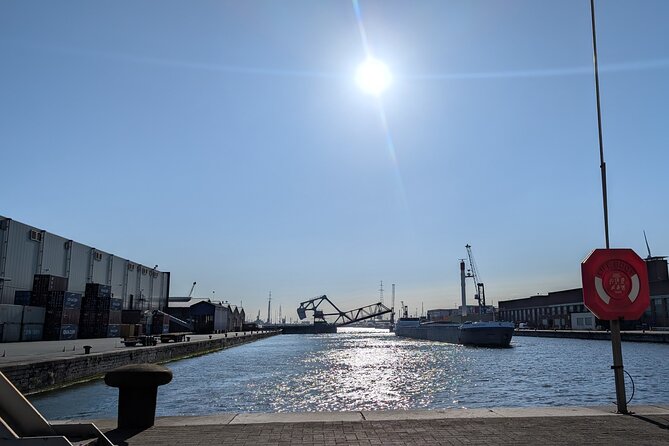
At Zandvlietweg, the group gets out near PSA’s quays at Dock 910. This is one of the clearest working-port viewpoints on the route.
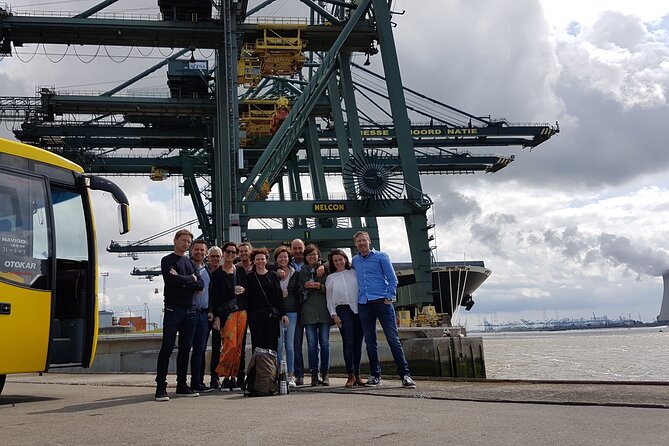
Straddle carriers move around the container area, and rows of cranes transfer cargo between ships and shore. From one location, the guide points out the Berendrecht and Zandvliet locks, the Belgium-Netherlands border running through the water, and the cooling towers of the Doel nuclear plant in the distance.
That combination makes this more than a crane stop. You see port work in front of you, national borders across the river, and major infrastructure beyond. It is a compact lesson in how industry, geography, and politics overlap here.
You have about 10 minutes outside the vehicle. Wear shoes suitable for standing near a working industrial area, and stay close to the guide’s instructions. The exact amount of visible activity will depend on what is happening at the terminal during your visit.
Lillo Fort, where old Antwerp survives
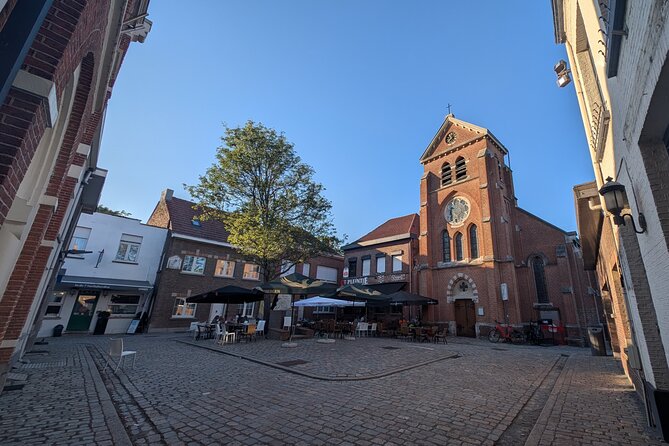
Lillo is the emotional center of the tour. After the tanks and locks, the vehicle turns onto the old roads of Lillo Fort. The change is immediate: cobblestones, grassy ramparts, a small dock, old fishermen’s houses, café smells, and resident geese.
The setting recalls a village that has held onto its identity beside an enormous port. The guide tells stories of Spanish sieges, smugglers, and local families. You get a sense of the old river community without needing a formal museum or long historical lecture.
This is the longest stop, at about 30 minutes, and it deserves the extra time. You can walk around, take photographs, and let the contrast settle in. Across the dike, chemical plants and industrial equipment remain close by. That tension is the point. Lillo is not a reconstructed village placed far from modern life. It exists next to the port’s heavy machinery.
If you want the most personal and atmospheric part of the route, this is it. It also helps explain why the earlier stories of vanished hamlets matter.
Antwerp North rail yard and the freight chain
The route next passes Antwerp-North Hump Yard. From the vehicle, you look down over a large marshalling yard where as many as 1,000 wagons can be rearranged in a day.
The guide explains the gravity-shunting process. Locomotives push mixed trains over a hump, individual wagons roll downhill, sensors and track retarders control their speed, and computer-operated switches place them into new trains. Those trains can then head toward Germany, France, or the Ruhr.
You may see the process happening, but timing is not guaranteed. Even a quiet moment remains useful because the guide shows how rail fits into the port system. Ships bring goods in, terminals sort them, and rail carries cargo far beyond Antwerp.
This drive-by completes the tour’s road, river, and rail story. The port is not only about ships. Its real reach comes from all the transport links working together.
Container Canyon and the final burst of port activity
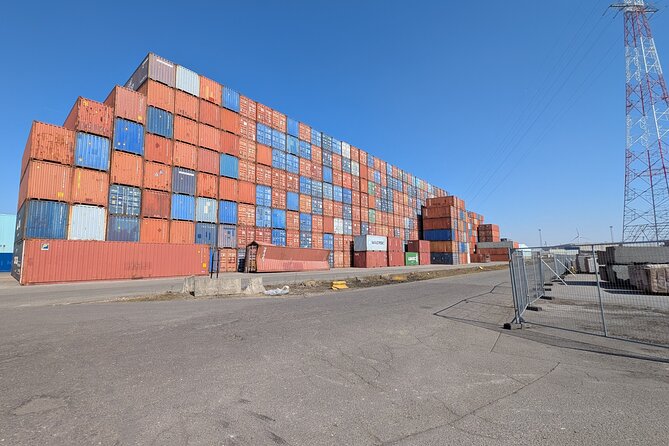
The final stop at Lubeckweg brings you into a maze of stacked containers. The route passes close enough to read container seals, with tall steel boxes forming narrow corridors around the vehicle.
On one side, large granite blocks await export. On the other, refrigerated containers serve Europe’s largest fruit terminal. Bananas and citrus can move from ship to supermarket in a short time, and the cooling equipment gives this section a distinct mechanical sound.
This is a quick five-minute stop, but it is a strong finish. You see raw materials, manufactured shipping units, refrigeration, and food distribution in one compact area. The port suddenly feels less like an abstract network and more like the reason certain products reach your kitchen.
What the $314.42 group price buys you
The price is $314.42 per group of up to 15 people. For one or two people, that is not a cheap outing. For a family or larger private group, the calculation changes because the cost is shared across the party.
The value comes from access and interpretation. You are covering a large port area in a private vehicle, with a guide who can explain what you are seeing and answer questions. The route includes places that are difficult to understand from central Antwerp or reach efficiently by public transport.
Still, remember what is not included. You need to bring the car, coach, or minibus, and the guide boards your vehicle. A larger group must arrange a suitable vehicle before the tour. Gratuities are included.
The tour is offered in English. One guide mentioned in the feedback, Laurens, is praised for a relaxed, story-led style. Niki is described as a multilingual guide with more than 40 years of maritime experience, including Luxembourgish. You cannot assume which guide you will receive, but the guide’s personality is an important part of the experience.
Who will enjoy this port tour
I would choose this for anyone curious about how a major port actually works, especially if you have already seen Antwerp’s old center and want a different side of the city. It suits families with older children, people interested in engineering or freight, and visitors who prefer explanation and local stories to a standard sightseeing circuit.
The advised minimum age is 12. Most people can take part, but the tour is not recommended for people with serious respiratory diseases because much of the route passes through an active industrial area. Service animals are allowed, and the meeting point is near public transport.
The tour requires good weather. If poor weather cancels it, you are offered another date or a full refund. You can cancel for a full refund up to 24 hours before the local start time. Changes or cancellations inside that window are not accepted.
Should you book it?
Book this tour if you want Antwerp beyond the cathedral and cobbled lanes, and if your group can provide a car or minibus. The strongest parts are the scale of Berendrecht Lock, the working container terminals, and the quiet surprise of Lillo Fort.
Skip it if you want a museum visit, a long walk, or a guaranteed close view of a large ship. Much of the route is viewed from the vehicle, and ship or rail activity depends on timing.
For a private group of several people, the price can be fair for the amount of territory covered. You get a rare look at the port’s industrial machinery, its freight connections, and the communities changed by expansion, all within one focused afternoon.
FAQ
Where does the Antwerp Port Tour begin?
The tour begins at Kinepolis Antwerpen, Groenendaallaan 394, 2030 Antwerpen, Belgium.
Where does the tour end?
The activity ends back at the meeting point at Kinepolis Antwerpen.
Is a vehicle included?
No. You must provide a car, coach, or minibus. The guide boards your vehicle during the tour.
How long is the tour?
The tour lasts approximately two hours and 30 minutes.
Is the tour private?
Yes. Only your group participates, with up to 15 people per group.
What happens if bad weather cancels the tour?
Because the experience requires good weather, you will be offered a different date or a full refund if it is canceled for that reason.
Just added around Belgium
- Excursion to Antwerp and Ghent by bus from Brussels with stop at the Atomium★ 4.5 · 18 reviews
- Ghent and Atomium Tour from Brussels★ 4.5 · 20 reviews
- Excursion to Bruges and Ghent by bus from Brussels★ 4.5 · 221 reviews
- Bruges bus tour from Brussels★ 4.5 · 28 reviews
- Excursion to Amsterdam by bus from Brussels★ 4.5 · 5 reviews
- Brussels Tootbus Discovery Hop-on Hop-off and Ferris Wheel★ 4.0 · 24 reviews
- Day trip to Ghent and Atomium from Brussels★ 4.5 · 64 reviews
- Bus day trip to Luxembourg and Dinant from Brussels★ 4.0 · 72 reviews
Shore Excursions, compared.
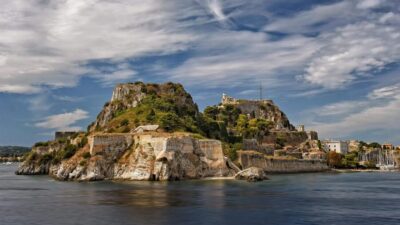
Corfu: Paleokastritsa Beach and Old Town Bus Shore Excursion
Read our review →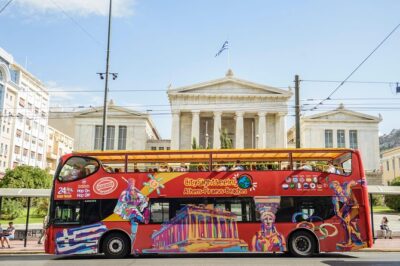
Athens Shore Excursion: Athens and Piraeus Hop-On Hop-Off Bus Tour
Read our review →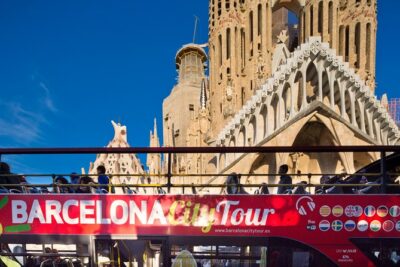
Shore Excursion: Barcelona City Tour Hop-On Hop-Off
Read our review →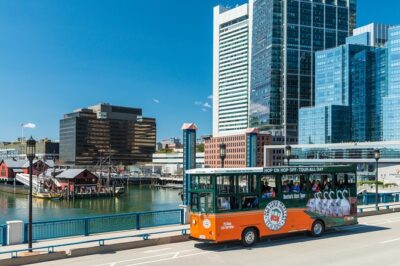
Boston Shore Excursion: Boston Hop-On Hop-Off Trolley Tour
Read our review →
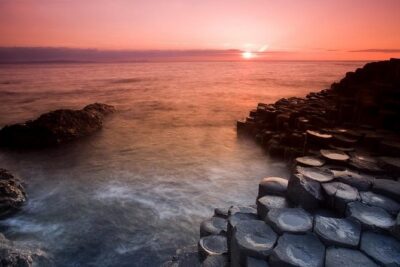
Shore Excursion: Giants Causeway Tour From Belfast Port (Extra Leg Room Bus)
Read our review →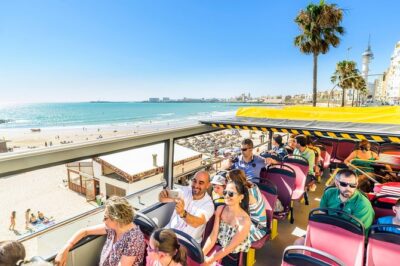
Cadiz Shore Excursion: City Sightseeing Cadiz Hop-On Hop-Off Bus Tour
Read our review →
Cruise Excursion Hop-On Hop-Off Tour & Rail Ticket
Read our review →Browse the lists this tour appears in