
REVIEW · BERLIN
Berlin: English Bus Tour to Sachsenhausen Concentration Camp
Sachsenhausen is not a quick photo stop. It is a large former concentration camp memorial where the layout, surviving buildings, and empty spaces force you to think about how the camp operated. I like that this tour begins the history lesson on the bus, and I like that guides such as Hannah, Klaus, Jamie G, Georgia, and Nikolai are praised for explaining the subject with care rather than turning it into a grim sightseeing show.
The private air-conditioned coach removes the fuss of arranging the trip from Berlin, and the guide gives you a useful framework before you arrive. The main drawback is time: two hours at Sachsenhausen is enough for a strong introduction, but not enough to read every display or explore every building at length. If you want a slow museum visit, you may feel hurried.
Key points to know before booking
- The bus ride is part of the lesson: Your guide explains the rise of Nazism, the war, Berlin, and the camp system on the way to Oranienburg.
- You visit the most important surviving areas: Expect the barracks, Tower A, infirmaries, crematoria, gas chamber area, execution trench, isolation cells, and punishment cells.
- The site is large: A guide helps you understand the layout and prevents the visit from becoming a confusing walk between scattered buildings.
- This is a serious, emotional outing: The subject is handled with respect, but you should be ready for disturbing information and quiet reflection.
- The $55 price buys convenience and interpretation: Transport, entry, a memorial donation, and a licensed English-speaking guide are included.
- Comfortable shoes matter: The tour involves walking outdoors, and it is not suitable for wheelchair users or people with limited mobility.
Why Sachsenhausen belongs on a Berlin itinerary
Sachsenhausen was built in 1936 as a concentration camp designed from the ground up. Its planned layout was meant to give the SS control over prisoners, staff, buildings, movement, and future expansion. That design is one of the first things that makes the site so sobering: the cruelty was not random or improvised. It was organized.
The camp later became part of a much larger system. Around 35,000 people were murdered there or died from disease and the brutal conditions. The memorial does not offer an easy, tidy story, and that is part of its value. You are asked to consider the prisoners, the administrators, the local population, and the machinery of persecution beyond the fences.
I think the guided format helps here. Without context, a former camp can look like a group of buildings and open ground. A good guide explains what each area was used for, how prisoners moved through the camp, and how the different parts worked together. The strongest guides on this tour, including Hannah, Georgia, Paul, Klaus, and Jamie G, are praised for combining clear facts with a calm, humane tone.
This is not a light half-day excursion to fit between shopping and dinner. Give yourself room afterward. The final part of the bus ride includes more history and, at times, personal stories about how Germany teaches and remembers this past. You may want a quiet evening after returning to Berlin.
A few more bus tours around Berlin worth a look
- Berlin: Hop-on Hop-off Bus Tour with Live Commentary
★ 4.3 · 8,579 reviews - Berlin: Big Bus Hop-On Hop-Off Sightseeing Tour & Currywurst
★ 4.4 · 4,638 reviews - Berlin: City Sightseeing Hop-On Hop-Off Bus Tour
★ 4.1 · 4,233 reviews
Meeting at Friedrichstrasse and leaving Berlin
The meeting point is outside Friedrichstrasse train station, on the square between the station and the Tränenpalast, also called the Palace of Tears. Look for a guide wearing a blue lanyard and yellow name tag, usually holding a yellow umbrella.
This location is practical because Friedrichstrasse is easy to reach by public transport, but allow enough time to find the correct side of the station. The listed address is Reichstagufer 17, 10117 Berlin. There is no hotel pickup, so you need to make your own way to the meeting point.
Once everyone is together, the group boards a private air-conditioned vehicle. The ride to Sachsenhausen takes about 50 minutes. That travel time is put to good use. Instead of simply watching Berlin pass by, you hear a background talk about the political conditions that led to Hitler’s rise, the development of the camp system, and the role of Sachsenhausen.
Several guides are singled out for making this bus commentary especially useful. Hannah is praised for clear explanations and thoughtful storytelling. Klaus is noted for linking the camp to the broader rise of Nazism. Jamie G is described as particularly strong on German and wartime history. One practical warning: a passenger reported that the coach microphone occasionally cut out, so sit fairly close to the guide if you want to hear every word.
The coach is one of the tour’s real advantages. You avoid figuring out the train connection to Oranienburg, changing transport, and finding the memorial entrance on your own. That convenience matters on a short Berlin visit, especially in poor weather.
Driving through Oranienburg
The route takes you through Oranienburg, the town associated with the camp. The guide uses this part of the journey to explain how the camp connected to the surrounding area and where prisoners were forced to work.
This is an important part of the experience because the camp was not an isolated world with no effect beyond the wire. The history lesson asks what local people knew, what they could see, and how the camp system affected everyday life around it. You will not get a complete tour of modern Oranienburg, but seeing the town on the way helps place Sachsenhausen within a real community rather than treating it as a remote historical site.
Do not expect a scenic coach tour. The value is in the commentary and context, not the view from the window. If the guide is speaking, listen closely. This background makes the later walk through the memorial easier to follow.
Entering through Tower A
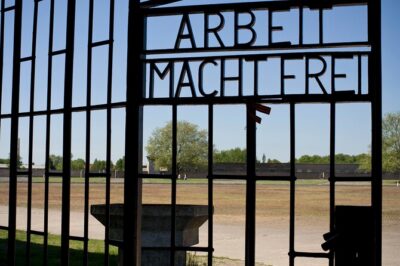
At the memorial, your guide leads you through the former camp layout, beginning with the entrance area and Tower A. The words Arbeit Macht Frei remain above the gate, a chilling reminder of the false promise used by the Nazi camp system.
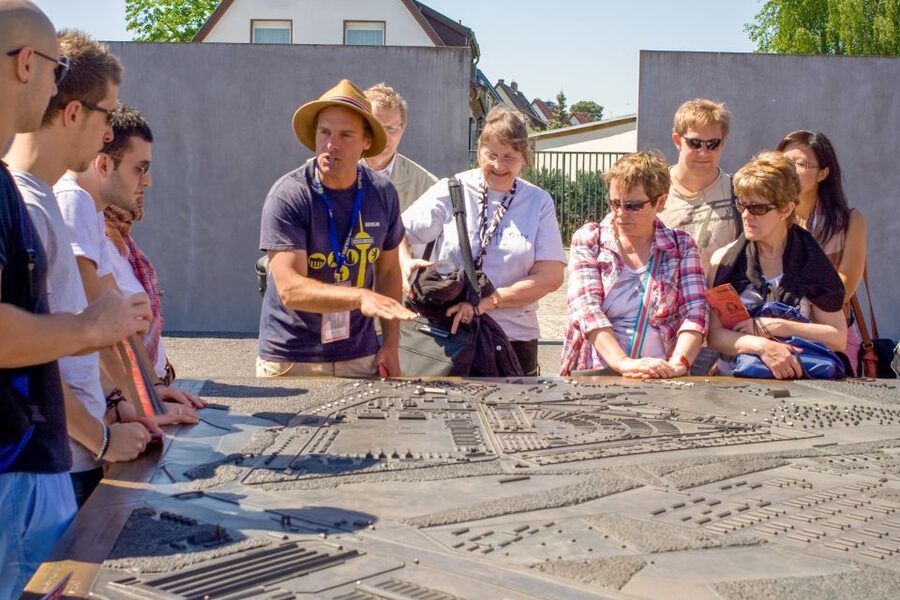
The entrance is not merely a famous image. It marks the point where prisoners were brought into a controlled system of registration, punishment, forced labor, hunger, illness, and death. Your guide explains the camp’s structure and the way the SS used architecture, rules, surveillance, and fear to control the people inside.
From here, Sachsenhausen’s planned shape becomes easier to grasp. The site was designed for command and efficiency. The open area, barracks, paths, and remaining structures show how physical space was used to strip people of privacy and freedom.
Your guide will likely pause at key points rather than rush from one building to the next. That matters. On a subject this difficult, clear explanations and a little silence are more useful than a nonstop stream of facts.
Same city, a different seat on the bus:
- Berlin: East and West Hop-On Hop-Off Bus Tour
★ 4.2 · 2,195 reviews - Sachsenhausen Concentration Camp Bus Tour in English from Berlin
★ 5.0 · 1,962 reviews - Berlin: 1.5-Hour Comedy Bus Tour in German
★ 4.5 · 1,165 reviews - Berlin City Hop-on Hop-off Tour with Optional Cruise
★ 3.5 · 1,155 reviews
Barracks, punishment, and daily life
The barracks provide some of the clearest sense of the prisoners’ daily conditions. You will learn about overcrowding, harsh routines, forced labor, discipline, and the brutal treatment imposed by guards and camp authorities.
The tour also includes punishment cells and isolation areas. These spaces are stark, and the guide explains how imprisonment inside the camp could involve additional confinement and punishment within an already oppressive system.
The original camp was larger than what you can fully explore in two hours. Some sections have been destroyed or altered, and the memorial uses surviving structures, outlines, displays, and marked spaces to explain what is no longer there. One person who had visited Dachau felt Sachsenhausen had fewer remaining buildings because of later destruction, including damage during the Soviet period. That is worth knowing before you go: the power of the site does not depend on every original structure still standing.
You will get an organized account of the camp rather than unlimited time in each exhibition. If you want to read every letter, photograph, and information panel, two hours will not be enough. I would treat this as a guided introduction, not the final word on Sachsenhausen.
Infirmaries and medical crimes
The infirmary barracks are among the most difficult areas on the route. These buildings were connected not only with illness and inadequate care, but also with medical experimentation during the war.
Your guide explains the difference between the camp’s medical functions and the crimes carried out under the appearance of medicine. That distinction is important. The infirmary was not a place of safety in the normal sense, and the displays make clear how prisoners were treated as objects rather than people.
This portion of the visit can be especially upsetting. You can expect a serious tone and disturbing details, though the guides are generally praised for choosing their words carefully. Hannah, Rebecca, Maria, and Will are among the guides noted for handling the subject with sensitivity and for giving the group space to think.
If you are visiting with teenagers, decide in advance how much detail is appropriate. One parent described the tour as suitable for a teenager, but the subject remains severe. The guide can help with context, yet no guide can make the material easy.
Crematoria, gas chamber area, and execution trench
The crematoria and gas chamber area form one of the most sobering parts of the route. You will hear how these facilities fit into the camp’s system of murder and the disposal of bodies.
The execution trench is another place where the camp’s function becomes brutally clear. The open setting can feel almost deceptively ordinary until the guide explains what took place there. This contrast between a quiet outdoor memorial and the crimes committed in that space is part of what makes Sachsenhausen so hard to process.
The tour also covers the commandant’s house. Seeing the place associated with camp administration shifts attention toward the people who planned, managed, and maintained the system. The visit is not only about prisoner suffering. It also examines the bureaucracy and authority that made such suffering possible.
Expect a lot of walking between areas. The ground can be uneven or exposed to the weather, and you may spend time standing while the guide speaks. Wear sturdy, comfortable shoes and weather-appropriate clothing.
Two hours at the memorial: enough or not enough?
The formal visit lasts about two hours. For many people, that is a reasonable balance. You receive a clear guided route through the major parts of Sachsenhausen without spending an entire day at a deeply distressing site.
The limitation is detail. You may have only a short time inside some exhibits, particularly if you stop to read every panel. One person specifically wished for more time with the letters and information inside the buildings. That is a fair criticism.
I would book this format if you want a structured first visit and prefer an expert explanation to finding your own way around. If you have already studied Sachsenhausen, or if museums usually take you several hours, you may want a longer independent visit instead. The bus tour does not try to show every corner. It selects the areas that best explain the camp’s operation and crimes.
The group format also affects the experience. You will move at the guide’s pace, and there may be limited time for individual questions. Some guides build in pauses and invite questions, while others keep a tighter schedule. If you have a particular subject you want to ask about, bring it up when the guide opens the floor.
The ride back to Berlin
After leaving the memorial, you return to Friedrichstrasse by coach in about 50 minutes. The ride back is not simply dead time. Guides often continue the discussion, covering Germany’s approach to remembrance and education today.
That final conversation is one of the more useful features of the tour. Sachsenhausen is not treated as a sealed-off tragedy from another country’s past. You are encouraged to think about how Germany presents this history, why memorial sites exist, and how the memory of the victims is kept active.
The tone on the return journey may be quieter than on the way out. That is appropriate. You have spent two hours hearing about murder, disease, forced labor, punishment, and medical abuse. A coach ride gives you some physical distance before you step back into central Berlin.
Is $55 a fair price?
At $55 per person, the tour costs more than arranging public transport and visiting the memorial independently. The price includes the private air-conditioned vehicle, driver, licensed English-speaking guide, entry to Sachsenhausen Memorial, a $3 donation to the memorial, and a map of the former camp.
The real question is how much you value interpretation. The memorial entry itself is only one part of the cost. You are also paying for a guide who explains the political background, camp layout, prisoner experience, and modern German remembrance. You do not need to work out the route from Berlin, handle train delays, or orient yourself across a large site.
I consider the price reasonable for a first visit, especially if you have only a few days in Berlin. The value depends heavily on your assigned guide. The strongest comments consistently praise guides such as Hannah, Klaus, Georgia, Jamie G, Paul, Nikolai, Scott, and Peter for clear English, strong subject knowledge, and compassion. A less clear speaker could make the coach commentary harder to follow, so sitting near the front is sensible.
The free cancellation up to 24 hours before departure and reserve-now, pay-later option also make it easier to fit the outing around changing plans. These policies do not change the emotional weight of the visit, but they are useful when arranging a short city break.
Practical advice for a respectful visit
Bring a light snack and a drink. There are toilet breaks, and the coach is comfortable, but you should not count on a full meal during the visit.
Wear comfortable walking shoes and clothing suited to the weather. Much of the experience takes place outdoors, and the memorial is not wheelchair accessible. It is not recommended for people with mobility impairments or walking difficulties.
You may bring a camera, but use judgment. This is a memorial site, not a backdrop for casual holiday pictures. Listen to the guide’s instructions and keep your behavior quiet and respectful.
Alcohol and drugs are not permitted. More importantly, arrive ready for a serious educational visit. If you are hoping for entertainment, this is the wrong excursion. If you want to understand how a concentration camp was organized and what happened to the people imprisoned there, it can be one of the most important outings from Berlin.
Should you book the Sachsenhausen bus tour?
Book it if you want a well-organized first visit with transport from central Berlin and a guide who can explain the camp within its political and social setting. The bus commentary is a major benefit, and two hours at the memorial gives you a clear route through the most significant areas.
Think twice if you need extensive time with every document and exhibit, have limited mobility, or find this subject too difficult for a holiday outing. You may also prefer an independent visit if you already know the history and want to set your own pace.
For most first-time visitors who want context, convenience, and a serious English-language guide, the $55 price is fair. Set aside the rest of the day for reflection rather than filling it with more sightseeing.
FAQ
Where does the Sachsenhausen tour meet?
The tour meets outside Friedrichstrasse train station, on the square between the station and the Tränenpalast, also called the Palace of Tears. The listed address is Reichstagufer 17, 10117 Berlin.
How long does the tour take?
The complete experience lasts about four hours. The coach ride takes roughly 50 minutes each way, and the guided visit at Sachsenhausen lasts about two hours.
Is the tour conducted in English?
Yes. The tour includes a live English-speaking guide.
What is included in the $55 price?
The price includes a professional licensed guide, private air-conditioned transport, a driver, Sachsenhausen Memorial entry, a $3 donation per person to the memorial, and a map of the former camp.
Is the tour suitable for wheelchair users?
No. The tour is not wheelchair accessible and is not recommended for people with limited mobility or walking impairments.
What should I bring?
Bring comfortable walking shoes, weather-appropriate clothing, a light snack, and a drink. Cameras are allowed, but alcohol and drugs are not permitted.
Just added around Berlin
- Sachsenhausen Concentration Camp Bus Tour★ 4.0 · 3 reviews
- Hop-on Hop-off Berlin Tour with Audio Guide★ 3.0 · 11 reviews
- Berlin Combo: Hop-On-Hop-Off Bus and Icebar Ticket★ 3.0 · 20 reviews
- Big Bus Berlin Panoramic Night Tour by Open-Top Bus★ 3.5 · 10 reviews
- Dresden: 10-Hour-Tour from Berlin by VW-Bus★ 5.0 · 5 reviews
- Berlin: Hop-On Hop-Off City Tour by Bus and Boat★ 4.4 · 488 reviews
- Potsdam: 5-Hour-Tour “Parks & Palaces” from Berlin by VW-Bus★ 5.0 · 17 reviews
- City Sightseeing Berlin: HOHO Bus – All Lines & Icebar★ 4.3 · 6 reviews
Berlin Bus Tours, compared.
Big Bus Hop-On Hop-Off Sightseeing Tour & Currywurst
Read our review →

Sachsenhausen Concentration Camp Bus Tour in English from Berlin
Read our review →
Berlin City Hop-on Hop-off Tour with Optional Cruise
Read our review →
Sightseeing Tour in Classic Volkswagen T1 Samba Bus
Read our review →Browse the lists this tour appears in