
REVIEW · EGYPT
Private Tour: Abu Simbel by Minibus from Aswan
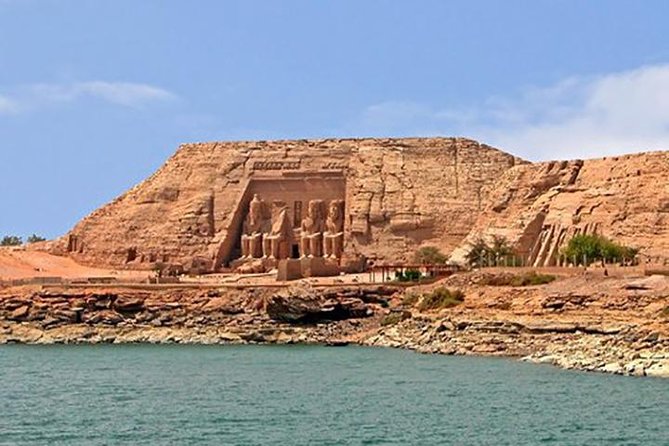
Abu Simbel is one of Egypt’s great payoffs: four giant figures of Ramses II greet you from a cliff beside Lake Nasser, while painted halls and carved rooms wait inside. The trip takes about three hours each way, but the temples are so imposing that the long desert run feels worthwhile. Private transport and hotel or port pickup make the day easier to manage.
I like the freedom to choose your departure time, and I like having an Egyptologist explain the temples before you enter. Guides are not allowed inside because of crowd control, so that briefing matters. The main drawback is simple: six hours on the road can leave you with too little time at Abu Simbel if the convoy runs late or your guide pushes for an early return.
Key points to know before you book
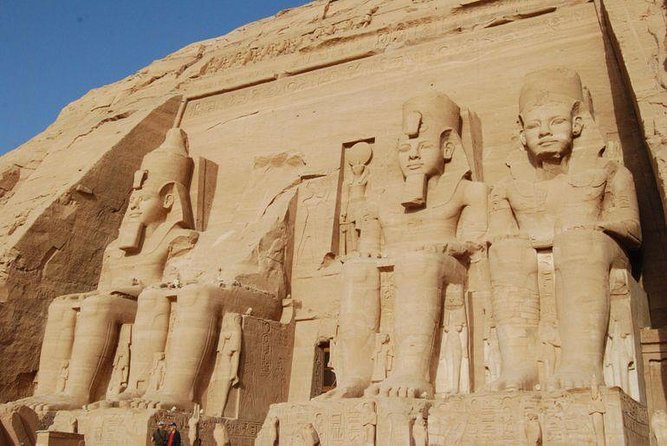
- The temples are the main event: Visit Ramses II’s Great Temple and the smaller Temple of Hathor, both carved and decorated in the 13th century BC.
- Plan around the convoy: Early departures around 3:45 or 4 a.m. can help you beat crowds, while later times may offer more sleep but less certainty about site time.
- Your guide briefs you outside: Guides cannot enter the temples, so listen carefully before exploring on your own.
- The drive is desert travel: Expect roughly three hours each way in an air-conditioned minibus, sometimes traveling with other vehicles for security.
- Private means private: Only your own party participates, with pickup from an Aswan hotel or port and return to the same type of location.
- The relocation story adds depth: If time permits, the visitor center explains how the temples were moved piece by piece to escape the rising waters of Lake Nasser.
Why Abu Simbel is worth the long road from Aswan
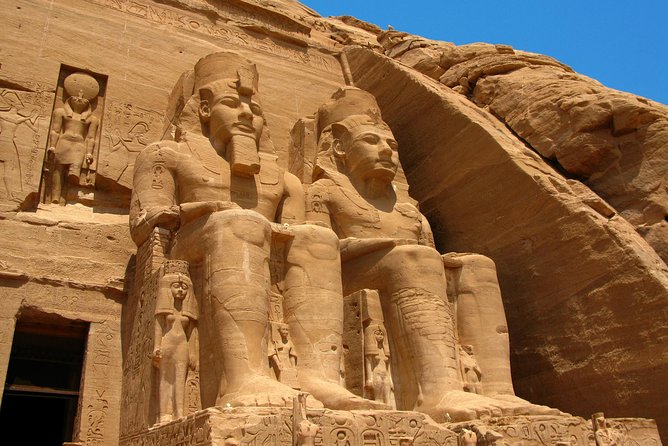
Abu Simbel is not a quick side trip. It is a full-day outing built around a distant monument, with about eight hours allowed from pickup to return. The payoff is one of the most memorable ancient sites in Egypt, and for many people it ranks just behind, or beside, the Great Pyramids.
The first view does much of the work. The Great Temple is cut into the rock and fronted by four enormous seated figures of Ramses II. His image appears again and again inside, along with military scenes, religious decoration, pillars, and painted surfaces that have survived for more than 3,000 years.
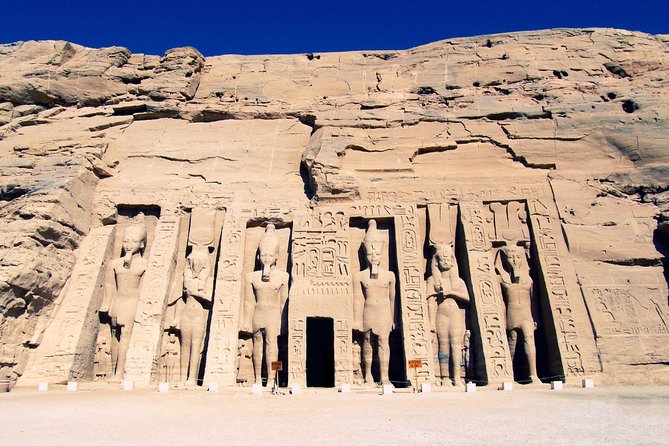
Beside it is the smaller Temple of Hathor, dedicated to the goddess Hathor and linked to Nefertari, Ramses II’s favored wife. Its scale is more modest, but do not treat it as an afterthought. The figures on the front include Ramses and Nefertari, and the interior carvings give the site a more personal feel than the huge royal temple next door.
The setting beside Lake Nasser also gives Abu Simbel a particular drama. The water is a reminder that these temples are not sitting exactly where the ancient builders left them. They were moved to higher ground in a major international conservation effort after the Aswan High Dam threatened to flood the original site.
A few more bus tours around Egypt worth a look
- Abu Simbel Temples Private Guided Tour from Aswan by coach
★ 4.5 · 16 reviews - Private Overnight Tour to Cairo from Hurghada by Bus
★ 5.0 · 2 reviews - UNESCO Tour: Alberobello and Matera by private bus from Bari
★ 4.8 · 2,871 reviews
Choosing the departure time from Aswan
The tour lets you request a departure time, but the road to Abu Simbel is not entirely yours to command. The trip commonly operates within a convoy system, with vehicles traveling together under instructions connected to road safety and the tourist police.
The earliest practical departures mentioned for this experience are around 3:45 or 4 a.m. That means a very early start, but it can put you at the temples before the largest crowds. One early departure also gives you a better chance of having enough time for both interiors and photographs before the return convoy.
Later departures can make the morning less punishing. One successful outing left Aswan at about 8:45 a.m., giving the group more sleep and still reaching Abu Simbel. Another outing began at 11:30 p.m., apparently timed to reach the temples at an unusual hour and enjoy a quieter visit. Since departure arrangements can vary, confirm the exact pickup time and the expected return convoy before setting your plans for the rest of the day.
My practical advice is to choose the earliest time if Abu Simbel is a top priority and crowds bother you. Choose a later start only if you value sleep more and can accept the possibility of a shorter visit. Ask the local operator how much time you should expect at the temples, not simply when the minibus leaves Aswan.
The three-hour desert drive
The road south from Aswan takes you through a stark desert setting toward the western shore of Lake Nasser. There is no parade of major sights along the way, so treat the journey as transport rather than sightseeing. You might spot camels, and you will see long stretches of open desert, but the main attraction comes at the far end.
The minibus is air-conditioned, and several people found the private vehicle comfortable. An onboard icebox was appreciated on at least one outing, which matters in hot weather. Bring water, and if you are leaving before dawn, a small pillow can make the ride more bearable. The road time is long enough that comfort is not a minor detail.
The convoy can also affect your schedule. A disorganized departure or a delayed return convoy has, on occasion, cut the temple visit to about an hour and fifteen minutes. That is enough to see the main façades and make a quick interior visit, but it is not generous for a place with two temples.
Driving standards can vary. Some outings had professional, punctual drivers, while others felt rushed or uncomfortable, especially after dark. One account described the return drive in darkness as unsettling because the driver was reluctant to use headlights. That is not a reason to reject Abu Simbel, but it is a fair reason to ask about the vehicle, the driver, and the return plan when confirming your booking.
Arriving at the Abu Simbel temple complex
From the minibus, you take a short walk toward the entrances. This is where your guide gives the main explanation of the site, including the discovery of the temples in 1813 and the enormous relocation project that followed the construction of the Aswan High Dam.
The guide uses photographs or illustrations to explain what you are about to see. This is especially useful because the guide cannot accompany you inside either temple. The restriction is connected to the large number of people visiting the complex, so you should listen before entering and ask your questions while you still have direct access to the guide.
A good guide can point out the purpose of the rooms, the placement of the statues, and the meaning of the wall scenes before you walk through. Several guides received warm praise for clear English, helpful explanations, and assistance with photos. Guides named Michael and Mark were singled out for professional service, with Mark described as well educated in Egyptology and good company during the long day.
The quality is not guaranteed, however. Some guides gave only a short briefing and struggled with basic questions. One guide spent much of the drive on a mobile phone, leaving the group with little useful commentary. Since the guide is one of the reasons to pay for a private tour, ask for a strong English-speaking Egyptologist and make clear that you want a proper site explanation, not just transport.
Same city, a different seat on the bus:
- VIP Day Trip to Cairo by Bus with Top Tour operators
★ 5.0 · 739 reviews - Day trip to Cairo by bus from Sharm el Sheikh
★ 4.5 · 334 reviews - Sharm El Sheikh: Great Pyramids, Sphinx, Museum Tour by Bus
★ 3.7 · 287 reviews - Sharm El-Sheikh: Full-Day Tour of Cairo and Pyramids by Bus
★ 4.8 · 237 reviews
Inside the Great Temple of Ramses II
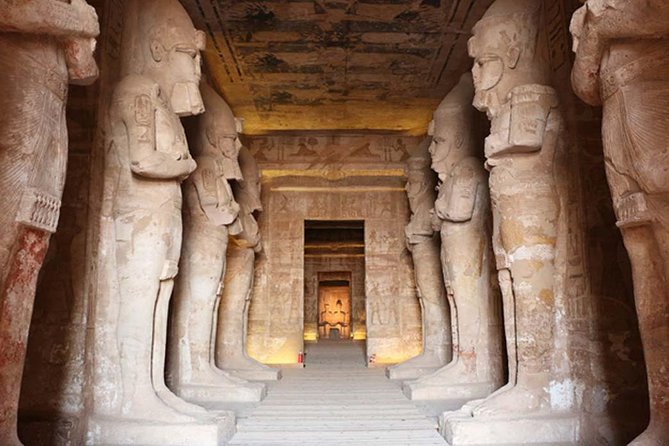
The Great Temple is where the scale of Abu Simbel becomes clear. Outside, the four seated Ramses figures dominate the rock façade. Inside, the rooms narrow the focus from giant royal images to painted scenes, carved pillars, and battle imagery linked to Ramses II’s rule.
You are free to explore the interior at your own pace after the outside briefing. Take a moment before moving quickly through the first rooms. Look at how the statues line the halls and how the walls use repeated images to present the pharaoh as ruler, warrior, and divine figure.
The temple can be crowded, and the available time may feel short. If you arrive late or the convoy has lost time, concentrate first on the main halls and painted battle scenes. Then look for smaller details on the pillars and walls. A guide’s explanation outside will help you understand what you are seeing, but the actual interior visit is self-guided.
Photography is part of the appeal, yet do not let the camera turn the visit into a checklist. The strongest memory is usually the transition from the bright open court into the dim, decorated interior, followed by the realization that the temple was cut from a cliff and later reconstructed elsewhere.
The Temple of Hathor and Nefertari
The smaller temple next door is dedicated to Hathor and honors Nefertari. Its façade has large royal figures, but the tone is different from the Great Temple. Nefertari appears at a scale similar to Ramses, an unusual honor in Egyptian royal art and one reason this temple deserves a careful visit.
Inside, look for murals and pillars showing Hathor and Nefertari. The rooms are less overpowering than those in the Great Temple, which makes it easier to focus on the carved figures and painted decoration. If your site time is limited, do not skip it automatically. A rushed visit to both temples is still better than spending the entire visit outside the Great Temple façade.
Your guide will not be inside to point out each image. Use the exterior briefing well, and consider asking the guide to describe the most important scenes before you enter. This is one of the few times on the tour when a private guide cannot offer help exactly where you need it.
The remarkable 1968 relocation project
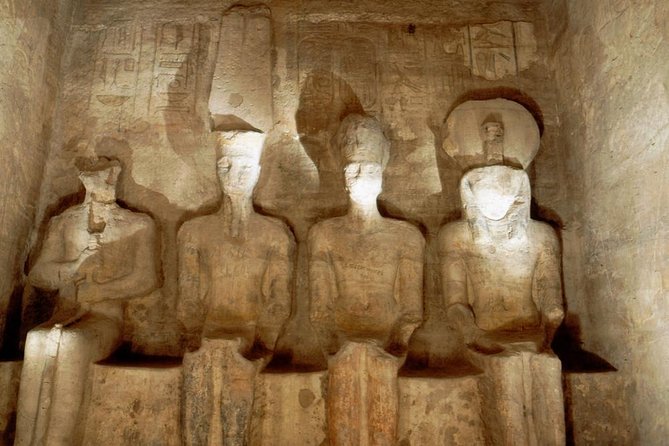
The temples’ modern story is almost as striking as their ancient one. When the Aswan High Dam was built, rising water threatened to cover Abu Simbel. An international UNESCO project dismantled the temples and moved them to higher ground in 1968.
The work was done piece by piece, including the rock face around the temples. The structures were then reassembled in a new setting above the future water level. The result is so carefully done that you may have trouble finding the seams between ancient material and modern reconstruction.
If the schedule allows, the group may stop at the nearby visitor center. It documents the relocation and helps you understand why the temples are now beside Lake Nasser rather than in their original position. This stop is worthwhile, but it should not come at the expense of the temples themselves. If you have only an hour at the complex, use that time inside first.
What the private format is really worth
The price is listed at $231.42 per person. That is a serious amount for a day trip, especially for one person, and some comparable arrangements in Aswan may cost less. The value depends heavily on group size and what you want from the day.
For two or more people, the private format buys you control over pickup, a vehicle reserved for your party, and direct contact with the guide. It is also useful if you are arriving by boat or train and need a planned pickup from the port or station. One outing included only two participants, which made the ride and site visit feel very personal.
The price is harder to justify if you are traveling alone and mainly need a ride to Abu Simbel. In that case, compare the cost with a hotel-arranged private car or another local option. You are paying for the Egyptologist, coordination, and convenience, but those benefits depend on receiving a strong guide and a well-run schedule.
The listed inclusions cover private air-conditioned transport, a qualified Egyptologist guide, pickup, and drop-off. The temple admission is included in the stated itinerary. Confirm exactly what is covered at booking, especially if you are comparing this with a lower-priced local arrangement.
Who should book this Abu Simbel trip?
I would consider this tour for a couple, family, or small group that wants a private vehicle and does not want to arrange the desert journey alone. It is also a sensible choice if you need pickup from an Aswan hotel or port and want one operator handling the day.
It suits people who place a high value on seeing Abu Simbel even when the timing is imperfect. The temples are the reason to go, and they are extraordinary. You should be comfortable with a long ride, an early start if you choose the crowd-avoiding option, and the chance that convoy arrangements will shorten your time at the site.
I would be more cautious if you expect detailed guiding inside the temples, a leisurely visit, or a luxury road experience. Your guide cannot enter the interiors, the minibus is practical rather than lavish, and the schedule may feel rushed. Also confirm that the operator will not add unwanted shopping stops. One outing had to wait while a papyrus shop issue was discussed, though the group ultimately avoided the stop.
Final verdict: book it for the temples, not the timetable
Abu Simbel is worth the effort. The giant Ramses figures, the decorated interiors, Nefertari’s temple, and the relocation story combine into a rare visit that feels both ancient and modern.
This particular tour offers useful private transport and a guide, but its value rests on timing and guide quality. I would book it if you can confirm an experienced Egyptologist, a clear departure and return plan, and enough time inside both temples. If those details remain vague, compare other local options before paying the premium.
Use the free cancellation policy as a safety net: you can cancel for a full refund up to 24 hours before the start time, while changes or cancellations inside that window are not accepted. For a once-in-a-lifetime site, that small bit of flexibility helps.
FAQ
How long does the Abu Simbel tour take?
The experience lasts about eight hours, including roughly three hours of driving each way between Aswan and Abu Simbel.
Where can pickup and drop-off take place?
Pickup and drop-off are offered at Aswan hotels and the Aswan port. A pickup from the train station was also arranged for one departure.
Is this a private tour?
Yes. Only your own group participates in the activity, with private transportation and a private Egyptologist guide.
What type of vehicle is used?
Transport is provided by an air-conditioned private minibus or minivan.
Which temples are included?
You visit the Great Temple of Ramses II and the smaller Temple of Hathor, associated with Nefertari.
Can the guide enter the temples with me?
No. Guides are not permitted inside the temples because of the high number of visitors. The guide explains the interiors outside before you enter.
Is admission to the temples included?
The itinerary states that the admission ticket is included.
Can I choose the departure time?
You can choose a preferred departure time when booking, but convoy and tourist police instructions may affect the final schedule.
Is there time to visit the relocation visitor center?
There may be time for a short visit if the schedule allows. The center explains how the temples were moved in 1968 to protect them from flooding caused by the Aswan High Dam.
What is the cancellation policy?
You can cancel at least 24 hours before the start time for a full refund. Cancellations or changes made less than 24 hours in advance are not accepted.
Just added around Egypt
- Full Day Cairo Tour from Hurghada by Minibus★ 5.0 · 2 reviews
- Luxor Full Day Sightseeing Tour by Bus from Hurghada★ 5.0 · 18 reviews
- 14 Days Egypt adventure Nile sahara desert bus tour★ 5.0 · 2 reviews
- Tour to Abu Simbel by bus★ 4.5 · 3 reviews
- Day Tour to Abu Simbel from Aswan by Bus★ 4.5 · 25 reviews
- Abu Simbel Temples Private Guided Tour from Aswan by coach★ 4.5 · 16 reviews
- Day Tour to Abu Simbel from Aswan by Bus★ 5.0 · 8 reviews
- Abu Simbel Excursion Day Trip from Aswan (Sharing Bus without Guide)★ 4.0 · 21 reviews
Egypt Bus Tours, compared.
VIP Day Trip to Cairo by Bus with Top Tour operators
Read our review →
Sharm El Sheikh: Great Pyramids, Sphinx, Museum Tour by Bus
Read our review →
Sharm El-Sheikh: Full-Day Tour of Cairo and Pyramids by Bus
Read our review →
Ras Mohamed National Park Half Day Tour by Bus In Sharm El Sheikh
Read our review →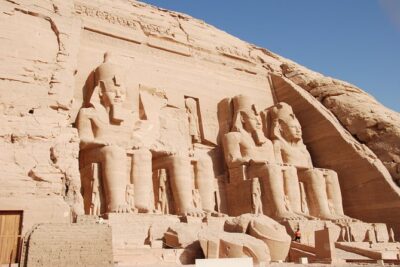
Abu Simbel Excursion 1 Day Trip from Aswan (Sharing Bus & Egyptologist Guide)
Read our review →
Pyramids Of Giza And Egyptian Museum Day Tour By Bus From Sharm
Read our review →
Browse the lists this tour appears in